

MuseFind Pricing Explained: Plans, Features & Review
Fifty dollars a month buys almost nothing in influencer software. Most discovery tools open at ten times that, and the platforms with real campaign machinery start in the four figures. So a single flat plan at $50 is worth understanding on its own terms rather than dismissing: MuseFind is a Vancouver-built influencer CRM aimed squarely at eCommerce owners who want to contact creators without buying enterprise infrastructure to do it. What you give up for that price is scale — the roster is 23,000 creators, not 23 million. In this article, we break down MuseFind pricing, key features, reviews, limitations, and the best MuseFind alternatives to consider.
MuseFind Pricing
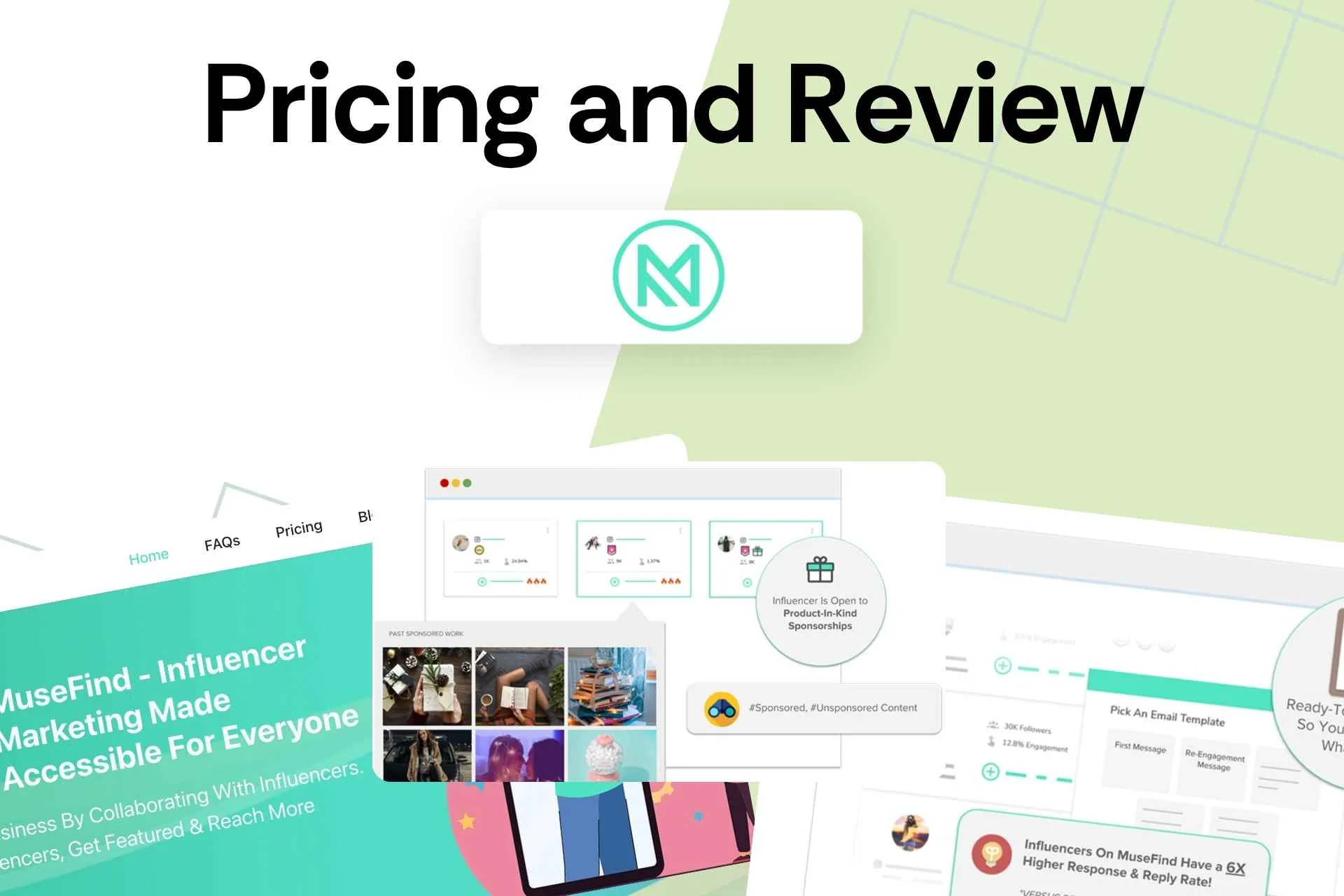
One plan, one price: $50 USD a month for the all-in-one package, which covers unlimited contact and collaboration with the platform's 23,000-plus creators, access to their credentials and past work, one-click messaging to multiple creators at once, preset and custom message templates, and a collaboration management workboard. There are no tiers, no seat pricing, and no usage meters published — genuinely simple, and rare enough in this category to be worth noting. Two caveats sit around that figure. First, the company's own About text on the same page describes the product as a free self-serve influencer CRM, which contradicts the $50 shown directly above it; ask which is current before assuming either. Second, MuseFind also offers what it calls white-glove full-service engagements for some clients, priced privately and arranged by email, so the $50 covers the software rather than any managed service. Third-party directories list a different figure again, in Canadian dollars and structured per feature, which does not match the vendor page.
Free Trial
No free trial is advertised on the pricing page, and software directories list the platform as having neither a trial nor a free version. The mismatch with the company's own description of a free self-serve CRM makes this the first thing to clarify by email before entering card details. Given the price, the practical evaluation is simply to buy one month and use it properly: search the roster for creators in your exact category, count how many are genuinely usable, and send a real outreach batch. Fifty dollars is a cheap way to answer the only question that matters here, which is whether 23,000 creators contains enough of the right ones for you.
Contract
No contract terms are published — no minimum period, no annual commitment, no cancellation notice. A flat monthly price with no stated lock-in normally implies month-to-month, and at this level the financial exposure is small either way. Still, confirm the cancellation route in writing before subscribing, since the platform's published documentation is thin and there is no independent review record to tell you how billing is handled in practice.
MuseFind Overview
MuseFind is an influencer CRM built by a Vancouver company founded by Jennifer Yemu Li Chiang, Andry Tanusdjaja, and Stephen Shen, and shaped by the ER Accelerator programme in New York. Its positioning has always been accessibility rather than scale: replace the spreadsheet and the scattered inbox with one workspace where creator contact, templates, and collaboration status live together. The roster covers roughly 23,000 vetted creators across eight categories including lifestyle, parenting, and technology, with credentials and past brand work visible on each profile. Around that sit batch messaging, five ready-made outreach templates, and a workboard for tracking collaborations in progress. The company reports reaching more than 150 million consumers through campaigns run on the platform and cites coverage in Forbes alongside sponsorship of New York Fashion Week, and it serves clients in North America and Asia-Pacific. It also publishes an Influencer Marketing Academy as an educational resource.
Key Features
Curated Creator Roster
Around 23,000 creators are available with verified engagement metrics, organised into eight broad categories — a shortlist-sized pool rather than a search problem.
Creator Credentials and Work History
Each profile shows professional background and past brand collaborations, which is the context that tells you whether a creator has worked with brands before or is new to paid partnerships.
One-Click Batch Messaging
Multiple creators can be contacted in a single action, which is where the platform saves the most time relative to manual DMs and individual emails.
Preset Outreach Templates
Five ready-made message templates cover the standard opening moves, with customisation available, so a first-time outreach effort does not start from a blank page.
Collaboration Workboard
Active partnerships are tracked on a shared board, giving a small team one view of who has been contacted, who replied, and what stage each collaboration has reached.
Influencer CRM Structure
Relationships and message history live in the platform rather than an inbox, which is the difference between remembering a creator and being able to find them again in six months.
Unlimited Contact on the Flat Plan
There is no cap published on how many creators you can message, so the monthly cost does not rise with outreach volume — unusual in a category that meters almost everything.
Full-Service Option
Beyond the software, MuseFind offers managed engagements for some clients, arranged privately, for brands that want the campaigns run rather than the tool supplied.
Educational Resources
The Influencer Marketing Academy provides guidance for teams new to the channel, which fits the platform's beginner-friendly positioning.
Best For
MuseFind fits small eCommerce brands and solo marketers taking their first structured run at influencer marketing, where the alternative is a spreadsheet and a series of Instagram DMs. At $50 a month it is one of the few paid options that a business testing the channel can justify before knowing whether it works, and the templates plus batch messaging remove the two things that most often stall a first campaign: not knowing what to say and not having the time to say it fifty times. It suits lifestyle, parenting, and consumer product categories, which is where the roster is concentrated. It is a poor fit for brands needing scale or precision — 23,000 creators will not support niche targeting, international campaigns, or a program running dozens of partnerships — and for anyone needing affiliate tracking, payments, or serious reporting.
MuseFind Reviews
No reliable public star rating
MuseFind has no user reviews on the major software directories: Capterra lists the product with a rating of zero from zero reviews, and there is no meaningful presence elsewhere. That is not evidence against the platform, but it does mean there is no independent verdict, no pattern of complaints, and no way to judge support quality or billing behaviour except your own experience. The signals that do exist are mixed in a way worth understanding. On the positive side, the site carries customer testimonials describing the contact process as straightforward, and the company has real credentials — an accelerator background, named founders, press coverage, and advisers from established technology companies. On the cautious side, the platform's public materials appear infrequently updated, the directory listing contradicts the vendor's own pricing, and the vendor page contradicts itself on whether the product is paid or free. None of that is disqualifying at $50, but it does mean the burden of verification sits entirely with you.
MuseFind Standout Features
A Price That Lets You Just Try It
Almost every platform in this category requires a demo, a quote, or an annual commitment before you can find out whether it works for your brand. Fifty dollars a month with no tiers means the evaluation is buying one month, which for a small brand is a materially different proposition from a procurement process.
Unlimited Outreach With No Meter
Discovery tools usually charge by profile unlock, audience report, or export, and the bill grows exactly as your program does. A flat fee with unlimited contact inverts that, so a busy month costs the same as a quiet one — the clearest argument for the platform if outreach volume is your bottleneck.
Templates Built Into the Workflow
Most platforms assume you know how to write to a creator. Shipping five templates alongside the roster acknowledges that first-time users often do not, and pairing them with batch sending means the advice and the action live in the same place rather than in a blog post you have to go find.
MuseFind Limitations
A Roster of 23,000, Not Millions
This is the defining constraint. Competitors index tens or hundreds of millions of profiles; MuseFind curates a small pool. That is fine for broad consumer categories and unworkable for niche products, specific countries, or campaigns needing dozens of creators at a particular follower tier.
No Independent Review Record
Zero reviews on the major directories means no external evidence about reliability, support, or billing. For a low monthly cost that is an acceptable risk, but it is a risk, not an absence of one.
Contradictory Public Pricing
The vendor page shows $50 a month while describing the product as free in the paragraph below, and third-party listings show a different figure again. Get the current price and terms in writing before subscribing.
Not a Full Campaign Platform
There is no affiliate link tracking, no commission handling, no creator payments, and no substantial analytics. MuseFind helps you find and contact creators and track conversations; measuring and paying for what they deliver happens elsewhere.


Is MuseFind Worth It?
Judged against enterprise platforms, MuseFind looks thin. Judged against the spreadsheet it is actually replacing for most of its users, it holds up: a curated roster, batch outreach, templates, and a workboard for $50 a month is a reasonable trade for a small brand that has never run a structured campaign. The concerns are real though — a small roster that will not stretch to niche or international work, no independent review evidence at all, contradictory pricing on the vendor's own page, and none of the tracking or payment machinery a maturing program needs. Brands that expect to outgrow that quickly should compare it against:
- Influencer Hero — an all-in-one platform with creator search across three networks, automated influencer outreach, CRM, gifting, affiliate tracking, and payouts, so the workflow does not stop at the first reply.
- Afluencer — a collaboration marketplace where brands post opportunities and creators apply, which suits small teams that would rather field inbound interest than work a limited roster.
- Heepsy — search-led creator discovery with audience quality checks and filtering, aimed at teams building shortlists on a budget.
- SARAL — lightweight creator relationship management with outreach and shipment tracking, built for lean eCommerce teams.
- Collabstr — a marketplace where brands browse and book creators with fixed package pricing, useful for one-off content buys.
Final Thoughts
The decision here comes down to one search. Before subscribing, ask MuseFind to confirm the current price in writing, then spend your first month querying the roster for the exact creators you want — right category, right country, right follower range — and count how many you would genuinely approach. If that number is twenty or more, $50 a month is an easy yes and the templates and batch messaging will earn it back in a week. If it is three, no amount of workflow polish will fix a roster that does not contain your creators, and you need a platform indexing a wider pool. That is a cheap test with a clear answer, which is more than most tools in this category offer.