

Minisocial Alternatives: Best Influencer Marketing Platforms
Paid social burns through creative faster than most in-house teams can produce it, and that gap is exactly what managed UGC services like Minisocial were built to close. Send a brief, and a batch of micro-creator videos comes back with commercial usage rights attached, no sourcing calls or contract negotiation involved. For a brand that needs assets on a deadline, it removes a real bottleneck.
The trouble starts with everything that happens after the files land. Campaigns open at $3,000 for ten creators, a floor that rules out smaller test budgets and puts the effective cost near $300 per deliverable. Coverage stops at Instagram and TikTok. And because the whole thing is managed on your behalf, none of the creator data, relationship history or performance signal ends up in your hands when the campaign closes.
Those three constraints — the budget floor, the narrow platform scope, and the absence of any owned infrastructure — are what push brands to compare Minisocial alternatives against proper influencer marketing software. A platform gives you a searchable creator database, outreach you can run at volume, a CRM that keeps every conversation in one record, and revenue attribution tied to individual partnerships. A service delivers assets once; software compounds what you learn.
The ten platforms below approach that from very different angles, from all-in-one programs and discovery-first tools to marketplaces built around finding and hiring micro-influencers: Influencer Hero, GRIN, Afluencer, Influencity, Upfluence, Modash, SARAL, Traackr, Heepsy and Kolsquare.
Criteria for Suggesting Platform Alternatives
Core Features
Evaluation of each platform’s essential capabilities, including influencer discovery, outreach, CRM, campaign reporting, gifting, UGC and content collection, affiliate tracking and payments, storefronts, application pages, and AI-powered tools.
Supported Social Media Platforms
Assessment of how well each platform integrates with major social networks such as Instagram, YouTube, TikTok, Facebook, Pinterest, and many more
Pricing & Contract Flexibility
Comparison of pricing models, subscription costs, and contract requirements to help brands choose solutions that match their budget and scalability needs.
Standout & Differentiating Features
Highlighting unique or innovative functionalities that set each platform apart, such as real-time tracking dashboards, creator benchmarking, TikTok email discovery, or advanced automation tools.
Customer Reviews & User Satisfaction
Analysis of verified user feedback from credible platforms like G2, TrustRadius, Capterra, focusing on usability, reliability, value for money, customer support, and real-world performance.
Minisocial Overview
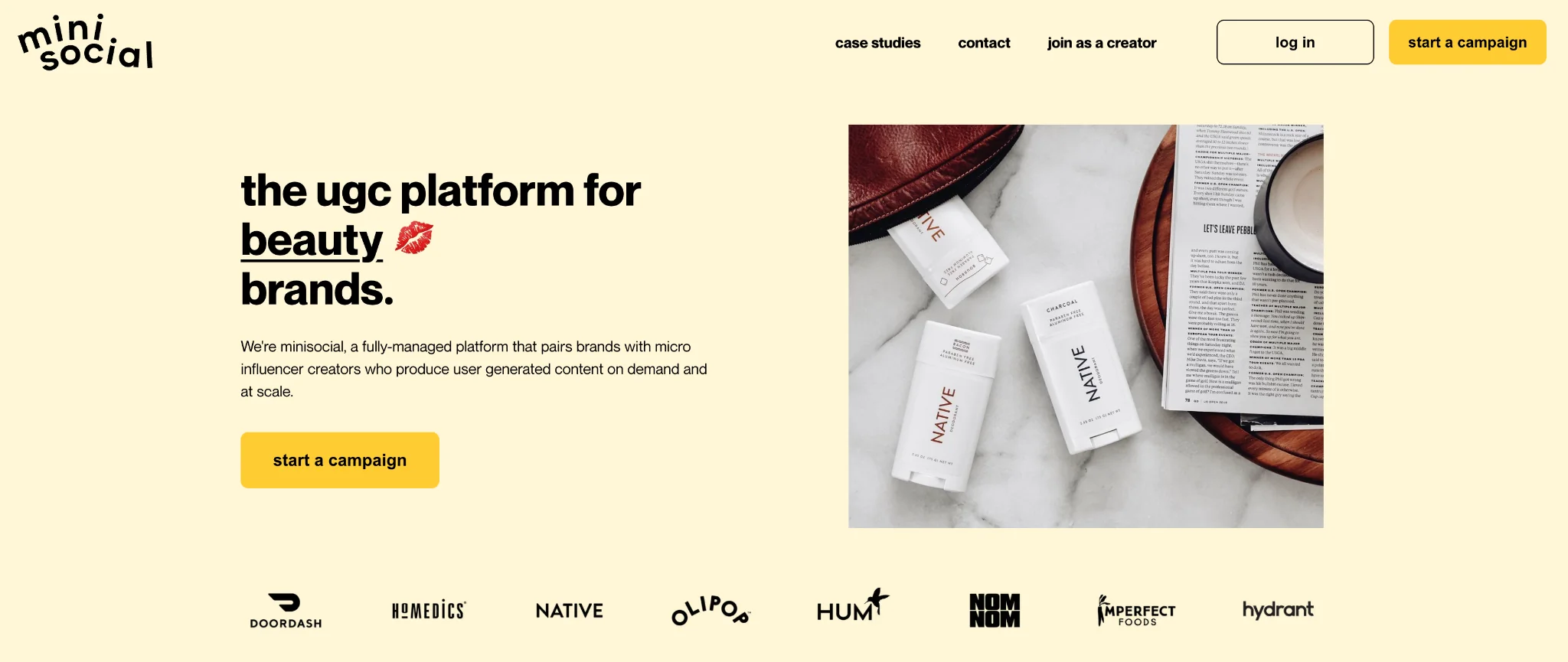
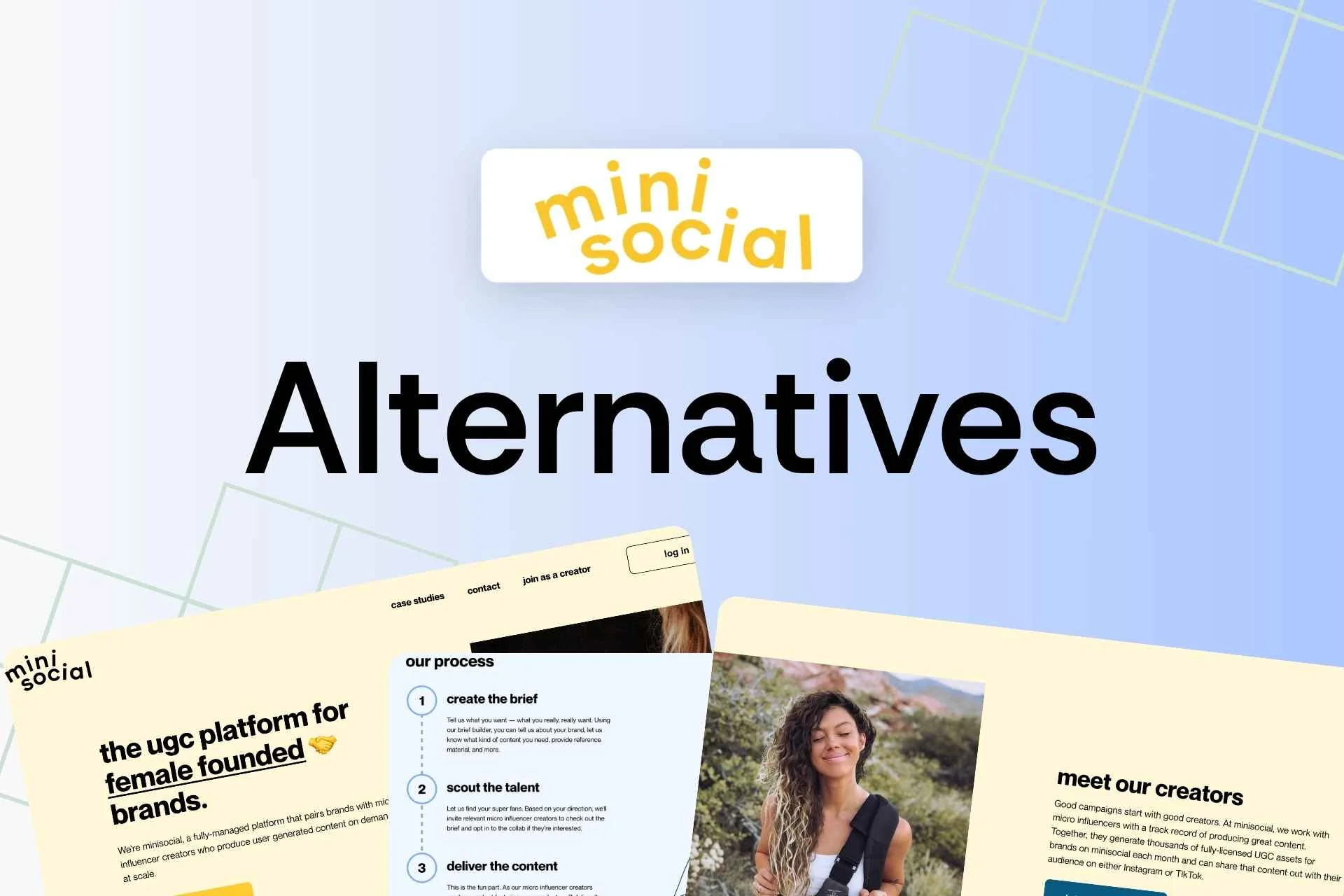
Minisocial is a fully managed micro-influencer and UGC service rather than a software product. Brands submit a creative brief, and Minisocial handles creator sourcing, product shipping, briefing and asset collection, then delivers licensed content that can be used across paid, organic, web and email. Each participating creator also posts to their own audience, so a campaign produces both usable assets and social proof.
Key Features
- Managed Creator Sourcing: Minisocial recruits and vets the micro-creators for each brief, so no outreach or negotiation sits with the brand.
- Brief Builder: Campaign requirements, messaging, product details and deliverable formats are set once at the start of the project.
- Mini License: Every delivered asset arrives with full commercial usage rights across paid media, web, email and print, with no expiry to renew.
- Product Seeding Logistics: Shipping and delivery coordination to each creator is handled as part of the campaign.
- Content Library: Finished videos and stills are collected in a delivery dashboard for download and internal distribution.
- Dual Deliverable: Creators publish to their own channels alongside handing over the licensed asset, combining content production with organic reach.
Platform Coverage
Instagram and TikTok, with the delivered assets licensed for use on any channel including paid ads, websites, email and print.
Pricing
- Campaign Minimum: $3,000 for a campaign of ten creators, with all creator fees and payments included.
- Effective Rate: roughly $300 per creator deliverable, scaling up as creator count increases.
- Licensing: commercial usage rights are bundled into the campaign price rather than charged separately.
- Commitment: project-based with no subscription, retainer or long-term contract.
Pricing is quoted per campaign rather than per seat, and there is no self-serve tier or free trial because the offering is a service rather than a tool. Larger campaigns of fifty to a hundred creators are quoted on the same per-creator logic.
Reviews
No reliable public rating. Minisocial has no established presence on the major software review sites, so there is no independent score to weigh against its own case studies.
Standout Features
- Perpetual Usage Rights: the licensing that usually requires separate negotiation and renewal is included in the base campaign price.
- Hands-Off Execution: sourcing, vetting, briefing, shipping and collection all sit with Minisocial, leaving the brand with only the brief.
- Content Plus Distribution: one creator fee buys both a licensed asset and a live post, instead of paying twice for production and reach.
Limitations (Why Users Look for Minisocial Alternatives)
High minimum campaign spend
Campaigns start at $3,000 for 10 creators, which can be expensive for smaller brands or teams that only want to test a few UGC assets.
Limited creative control
Since minisocial is a fully managed service, brands have less control over creator selection and the production process than they would with a self-serve platform.
Project-based rather than ongoing
Each campaign is a separate engagement, which may be less suitable for brands looking to build and manage a continuous creator program or owned creator network.
Limited performance analytics
minisocial focuses primarily on content creation, licensing, and creator amplification rather than providing robust built-in analytics for tracking content performance.
10 Best Influencer Marketing Platform Alternatives:
| TOOL | REVIEWS | BEST FOR | TRIAL INFO | PRICING | ||
|---|---|---|---|---|---|---|
1 |
|
⭐ | Influencer CRM & automation | Book Demo | Pricing | Website |
2 |

|
⭐ | DTC creator management | Book Demo | Pricing | Website |
3 |

|
⭐ | Influencer marketplace campaigns | Book Demo | Pricing | Website |
4 |
|
⭐ | Campaign management | Book Demo | Pricing | Website |
5 |

|
⭐ | Influencer discovery | Book Demo | Pricing | Website |
6 |

|
⭐ | Influencer discovery | Book Demo | Pricing | Website |
7 |

|
⭐ | Influencer outreach | Book Demo | Pricing | Website |
8 |

|
⭐ | Enterprise influencer analytics | Book Demo | Pricing | Website |
9 |

|
⭐ | Influencer discovery | Book Demo | Pricing | Website |
10 |

|
⭐ | Data-driven influencer discovery & campaign analytics | Book Demo | Pricing | Website |
Influencer Hero

Influencer Hero is an all-in-one influencer marketing platform covering discovery, outreach, CRM, gifting, affiliate tracking and ROI reporting in a single system. It is built for D2C and eCommerce teams that want to run seeding and creator programs at scale in-house, and it supports enterprise-level volume alongside growing brands. The automation layer is the centre of gravity, with bulk outreach, drip sequences and auto-fulfilled gifting reducing the manual work that usually caps program size.
Key Features
- Influencer Discovery: advanced filtering by location, demographics, interests, engagement and follower quality, with fake-follower detection and lookalike suggestions.
- Automated Outreach: bulk or one-to-one emails with AI-personalised templates, drip sequences and reply tracking.
- Influencer CRM: relationship boards that track communication, campaign stage and deliverables for every creator in the program.
- Gifting and Seeding: Shopify and WooCommerce auto-fulfilment with shipping and delivery tracking built in.
- Affiliate and Payments: custom links, discount codes, commission and conversion tracking, and automated creator payouts.
- UGC Collection: influencer posts are collected automatically and made downloadable for repurposing across paid and owned channels.
- Storefronts and Application Pages: branded creator storefronts that drive affiliate sales, plus landing pages for inbound influencer applications.
- ROI Reporting: real-time dashboards covering clicks, affiliate sales, UGC downloads and revenue per influencer, with exportable reports.
Platform Coverage
Instagram, TikTok, YouTube, Facebook, Pinterest, Snapchat, X and Twitch.
Pricing
- Standard: $649/month for up to 1,000 creators or contacts.
- Pro: $1,049/month for up to 5,000.
- Business: $2,490/month for up to 10,000.
- Custom and Agency: tailored pricing for larger programs and multi-client teams.
Reviews
5.0/5.0 (Capterra)
Standout Features
- CRM Automation at Scale: bulk tools for outreach, follow-ups, seeding and deal management that keep large seeding programs manageable.
- Revenue Attribution Per Creator: affiliate sales, clicks and ROI reported at the individual influencer level rather than campaign level.
- Integration Depth: DocuSign, GoAffPro, Klaviyo, Slack, Zapier and hundreds more, plus an API with access to millions of creator profiles.
Minisocial vs Influencer Hero
The two solve genuinely different problems. Minisocial produces a finite batch of licensed assets and closes the loop there; Influencer Hero gives you the machinery to source, contact, gift, track and pay creators continuously. The practical difference shows up in month three — a Minisocial campaign ends with files in a folder, while an Influencer Hero program ends with a creator database, a record of who performed, and affiliate revenue attributed to specific partnerships you can renew.
Minisocial's advantage is real and worth naming: zero operational lift, and licensing handled cleanly in one price. But the $3,000 floor buys ten deliverables rather than a system, and at $649/month Influencer Hero covers a thousand creator contacts across eight networks with automated gifting, UGC collection and ROI reporting attached. For brands that intend to run creator marketing as an ongoing channel rather than a one-off content order, the owned-program route compounds where the managed batch does not.
GRIN
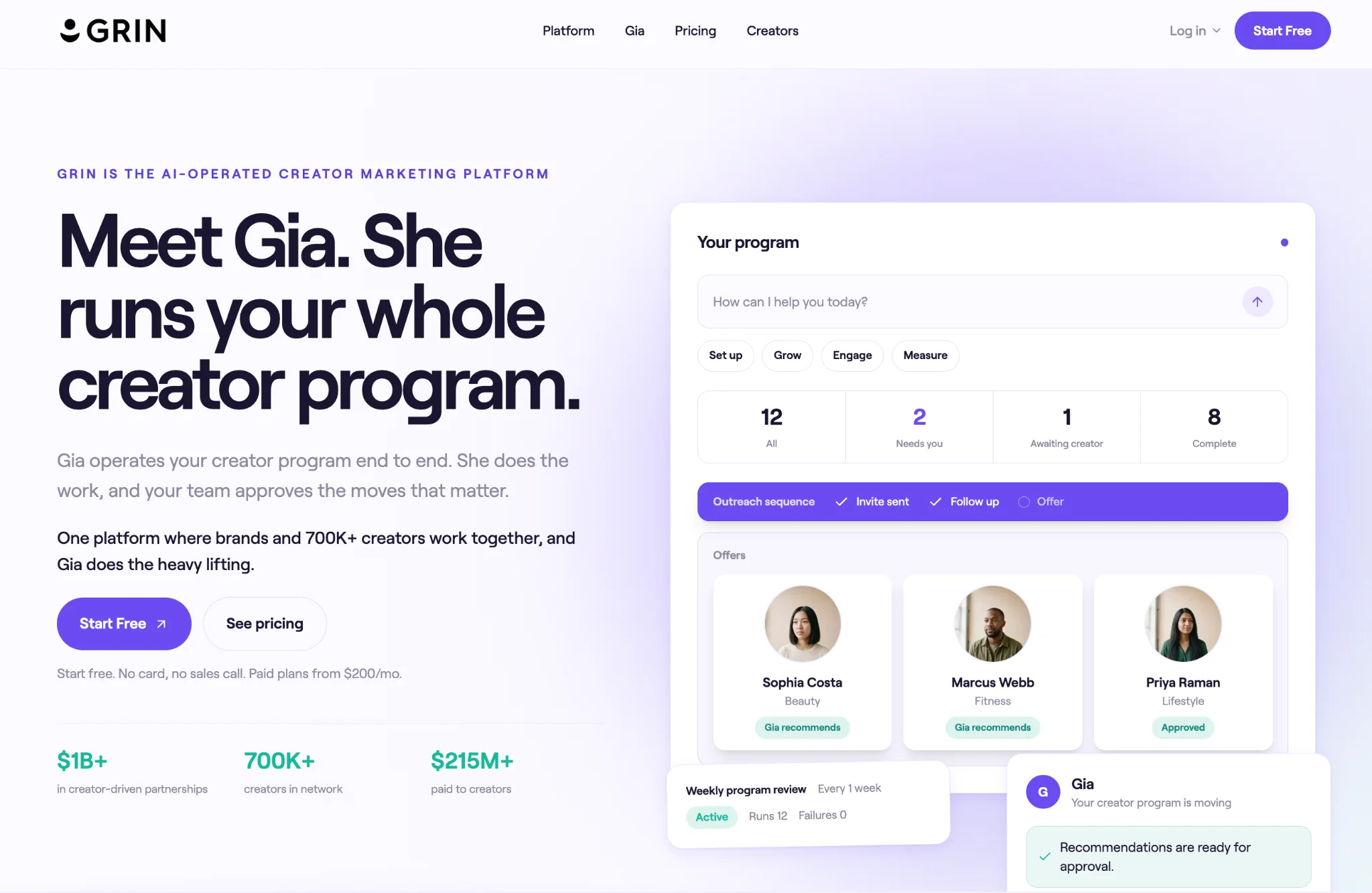
GRIN is a creator management platform aimed at D2C and eCommerce brands running influencer programs in-house. It has rebuilt around an AI agent called Gia that executes discovery, outreach, negotiation, payments and reporting, with the original workflow product retained alongside it. Pricing is now usage-based and self-serve, which is a meaningful shift from its previous enterprise-only posture.
Key Features
- AI Agent Execution: Gia carries out program tasks such as discovery, outreach and payment processing rather than only recommending them.
- Creator CRM: a central relationship record holding partnership history and performance data for every creator.
- Creator Marketplace: access to a large pool of opted-in creators with no commission taken on affiliate programs.
- Guided Setup: brand goals and audience criteria are used to build the initial creator shortlist automatically.
- Flexible Reporting: report templates that can be configured for different internal stakeholders.
Platform Coverage
Facebook, Instagram, TikTok, X, Pinterest, YouTube and Twitch for activation, with creator search focused on the major video and social networks.
Pricing
- Free: $0/month with a monthly credit allowance and no card required.
- Starter: $200/month with metered usage under a brand-set cap.
- Growth: $500/month, adding the classic workflow product for up to 100 active creators.
- Scale: $1,000/month for up to 250 active creators.
- Complete: $1,500/month for up to 500 active creators.
Reviews
4.5/5.0 (G2)
Standout Features
- Agentic Automation: program work is executed end to end rather than queued for a human to approve step by step.
- Permanent Free Tier: a no-card entry point that lets teams evaluate the product without a sales cycle.
- Credit-Based Billing: cost scales with work done instead of seats, which suits teams with uneven campaign volume.
Minisocial vs GRIN
Minisocial sells output; GRIN sells throughput. A brand that only wants twenty tested video assets for paid social gets there faster with Minisocial and never touches a dashboard. A brand that wants to identify creators, negotiate, ship product, track posts and pay out repeatedly is buying an operating system, and that is what GRIN is priced and built to be.
The cost comparison is less lopsided than it looks. GRIN's $200/month starter tier costs less in a year than one Minisocial campaign, though creator fees sit on top and the brand supplies the labour that Minisocial otherwise absorbs. Where GRIN genuinely wins is continuity — every negotiation, post and payout stays in the CRM, so the second year of a program starts from a warm roster rather than a fresh brief.
Afluencer
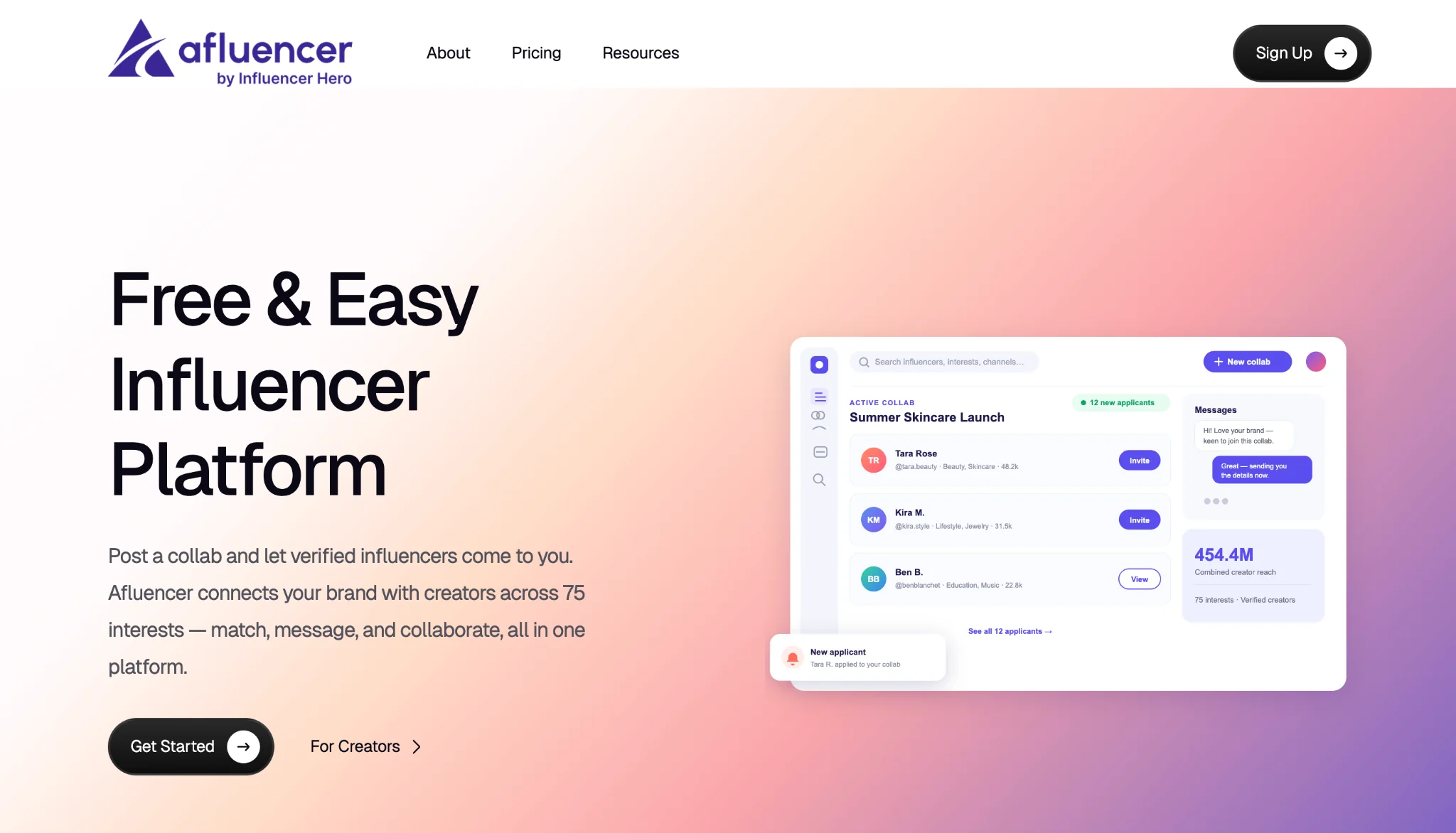
Afluencer is a two-sided marketplace where brands post collaboration offers and verified creators apply to them, rather than the brand cold-sourcing from a scraped database. It leans heavily toward SMB and D2C brands, particularly on Shopify, and toward creators looking for paid, gifted and affiliate partnerships. The inbound model means the brand spends its time reviewing interested creators instead of chasing unresponsive ones.
Key Features
- Collab Marketplace: brands publish collaboration offers and creators apply directly, inverting the usual outreach workflow.
- Verified Creator Network: profiles belong to real registered users rather than scraped accounts.
- Creator Directory Search: a large searchable database segmented across dozens of interest categories.
- Built-In Messaging: matching, direct messages and collaboration tracking all live inside one dashboard.
- Product Send-Outs and Payments: paid brand tiers add gifting logistics and creator payment handling.
Platform Coverage
Instagram, TikTok, YouTube and X.
Pricing
- Marketplace: free, with collab posting and access to the creator network.
- Standard: $649/month including 1,000 reach-outs per month, product send-outs and influencer payments.
- Pro: $1,049/month including 5,000 reach-outs, a dedicated account manager and additional seats.
Reviews
4.6/5.0 (G2)
Standout Features
- Genuine Free Tier: brands can post collabs and receive applications without paying anything up front.
- Inbound Application Model: creator interest arrives pre-qualified, which removes most cold outreach volume.
- eCommerce Integrations: Shopify, Klaviyo, Amazon, Slack and DocuSign connections support the operational side of collabs.
Minisocial vs Afluencer
The contrast here is cost structure more than capability. Minisocial charges $3,000 to run ten creator collaborations on your behalf; Afluencer lets a brand post the same brief for free and field applications directly, paying only the creators it selects. For a team willing to review submissions and manage the conversation, that difference is the entire budget floor.
What Minisocial provides in exchange is guaranteed delivery and clean licensing — a marketplace collab can go quiet, and usage rights have to be agreed collab by collab. Afluencer's advantage is repeatability and reach: a brand can keep several collabs live across Instagram, TikTok, YouTube and X simultaneously, build a roster of creators who have already applied once, and re-engage them without paying a new campaign minimum each time.
Influencity

Influencity is an AI-powered influencer management platform that also folds in social media management and social listening, which is unusual in this category. It serves brands, agencies and eCommerce teams across a wide range of markets, and its modular structure lets buyers pay for the pieces they need rather than a full enterprise suite. The database sits in the hundreds of millions of profiles.
Key Features
- Influencer Discovery: search across a very large profile database with audience demographic and engagement filtering.
- Influencer Relationship Management: custom creator databases and talent rosters with performance history attached.
- Campaign Manager: casting, briefing, content validation and approval handled in one workflow.
- Social Hub: a content calendar, scheduling and a unified comment and DM inbox alongside the influencer tooling.
- Monitoring and Listening: brand mentions, competitor tracking and trend detection built into the same platform.
Platform Coverage
Instagram, TikTok, YouTube and Twitch.
Pricing
- Professional: around $398/month, or roughly $318/month when billed annually.
- Business: in the region of $700–800/month for larger teams and higher usage limits.
- Enterprise: custom pricing with tailored limits and support.
A seven-day free trial is available across plans, and pricing is modular, so teams that only need discovery pay less than teams adding listening and campaign management.
Reviews
4.5/5.0 (G2)
Standout Features
- Three Tools in One: influencer marketing, social media management and social listening in a single subscription.
- Modular Purchasing: capability is added in pieces rather than bought as an all-or-nothing suite.
- Self-Serve Trial: a genuine trial without a mandatory sales call, which is rare at this price point.
Minisocial vs Influencity
These two barely overlap, which makes the choice unusually clean. Minisocial is a content supplier; Influencity is a research and management layer that produces no content at all. A brand using Influencity still has to brief, negotiate and collect assets itself — what it gets in return is the ability to find the right creators before spending anything on them.
Where that matters most is repeat spend. Minisocial selects creators for you, so the selection logic never becomes yours; if a campaign underperforms, you have limited insight into why. Influencity's audience data, credibility scoring and campaign records let a team see which creator profiles actually converted and search for more like them, turning each round into an input for the next rather than a standalone purchase.


Upfluence
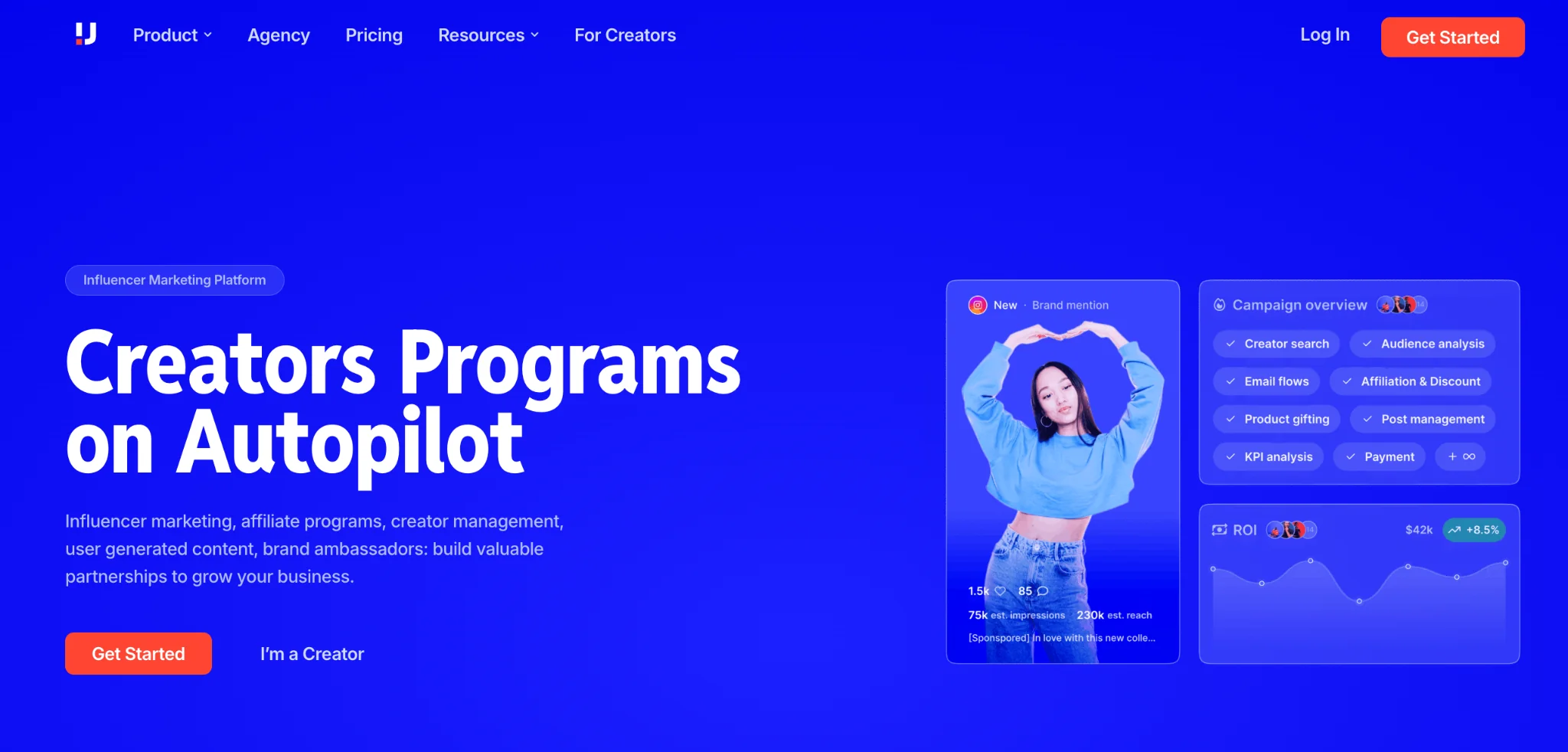
Upfluence combines influencer and affiliate marketing for eCommerce brands and agencies, with unusually deep integration into commerce data. Its defining trick is identifying existing customers who also happen to be creators, turning a brand's own buyer list into a partnership pipeline. It sits toward the enterprise end of the market in both capability and commercial process.
Key Features
- AI Co-Pilot: automates creator selection and outreach drafting to compress manual research time.
- Customer-to-Creator Matching: eCommerce and email integrations surface customers who already have audiences.
- Cross-Network Discovery: creator search with audience and performance data presented side by side.
- Sales Attribution: revenue tied to individual creators through Shopify, WooCommerce, Magento, BigCommerce and Klaviyo connections.
- Global Payments: multi-currency payouts with tax forms and compliance handled in-platform.
Platform Coverage
Instagram, TikTok, YouTube, Twitch, Pinterest and X.
Pricing
- Modular Plans: three plan tiers covering discovery, program scaling and full automation, quoted individually.
- Custom Quote: no public pricing; cost depends on modules, team size and program volume.
- Contract: a twelve-month minimum commitment applies, with a fixed platform fee and no cut of creator-driven sales.
Reviews
4.6/5.0 (G2)
Standout Features
- Broadest Discovery Coverage: six networks searchable from one interface, more than most competitors offer.
- Own-Customer Sourcing: creator partnerships built from people who have already bought, which tends to convert better.
- Compliant Global Payouts: international payments and tax documentation handled without a separate finance workflow.
Minisocial vs Upfluence
The gap here is commitment. Minisocial asks for $3,000 and a brief; Upfluence asks for a sales conversation and a twelve-month contract. That makes Minisocial far easier to trial and Upfluence far harder to abandon, which cuts both ways depending on how certain a brand is about the channel.
For brands already running meaningful eCommerce volume, Upfluence's customer-to-creator matching is the argument. Recruiting advocates from an existing buyer list produces partnerships with genuine product familiarity, and the platform then attributes revenue back to each one. Minisocial's creators are sourced from a pool that has no prior relationship with the brand, which is fine for generic UGC but weaker when authenticity and repeat advocacy are the point.
Modash
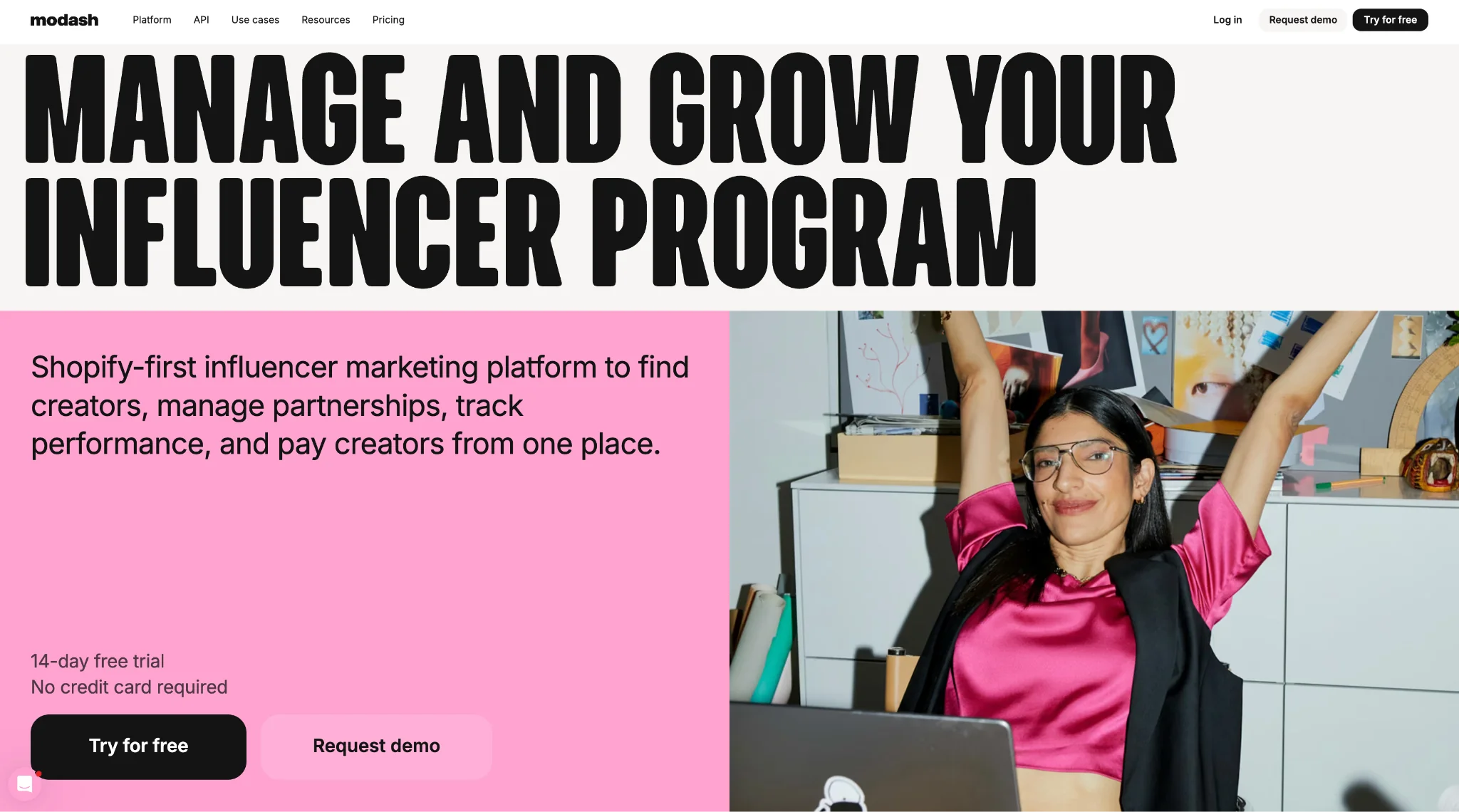
Modash is a creator marketing platform built for in-house teams at eCommerce and D2C brands, with a strong Shopify orientation. Its defining design choice is that creators never need to sign up or connect an account — the platform indexes public profiles, so tracking works on any creator. Pricing is fully published, which makes it one of the easier tools to evaluate without a sales process.
Key Features
- Creator Discovery: AI search across hundreds of millions of profiles, covering every account above a low follower threshold.
- No-Signup Tracking: creator content is detected and monitored automatically without the creator joining the platform.
- Creator CRM: contacts, notes and collaboration history stored in one record per creator.
- Synced Email Inbox: Gmail and Outlook threads pulled in with campaign context attached.
- Creator Payments: international payouts with no processing fee up to defined annual volumes.
Platform Coverage
Instagram, TikTok and YouTube.
Pricing
- Essentials: $199/month for two seats and limits suited to programs of up to 100 creators.
- Performance: $499/month for five seats, adding payments and affiliate management.
- Enterprise: from $14,700/year with custom limits, a dedicated success manager and a custom tracking domain.
A fourteen-day free trial is available with no credit card required, capped at a limited number of profile views and tracked creators.
Reviews
4.9/5.0 (G2)
Standout Features
- Signup-Free Content Tracking: posts are captured without asking creators to authorise anything, which removes a common drop-off point.
- Influential Fans: surfaces creators already following or engaging with the brand as warm partnership candidates.
- Transparent Trial: a no-card, no-call trial that lets teams test the database before committing.
Minisocial vs Modash
Minisocial answers "get me content"; Modash answers "get me the right creators and prove what they did". A brand that struggles to find partners will get more out of Modash's database and tracking than out of a managed batch, because the underlying problem is selection rather than production capacity.
The economics also diverge sharply at low volume. Modash's $199/month entry plan costs less per year than a single Minisocial campaign, though the brand pays creators separately and does the outreach itself. What that buys is visibility — every post tracked, every creator scored, every campaign comparable to the last — where a managed service leaves the brand holding assets and very little evidence about which creator choices worked.
SARAL
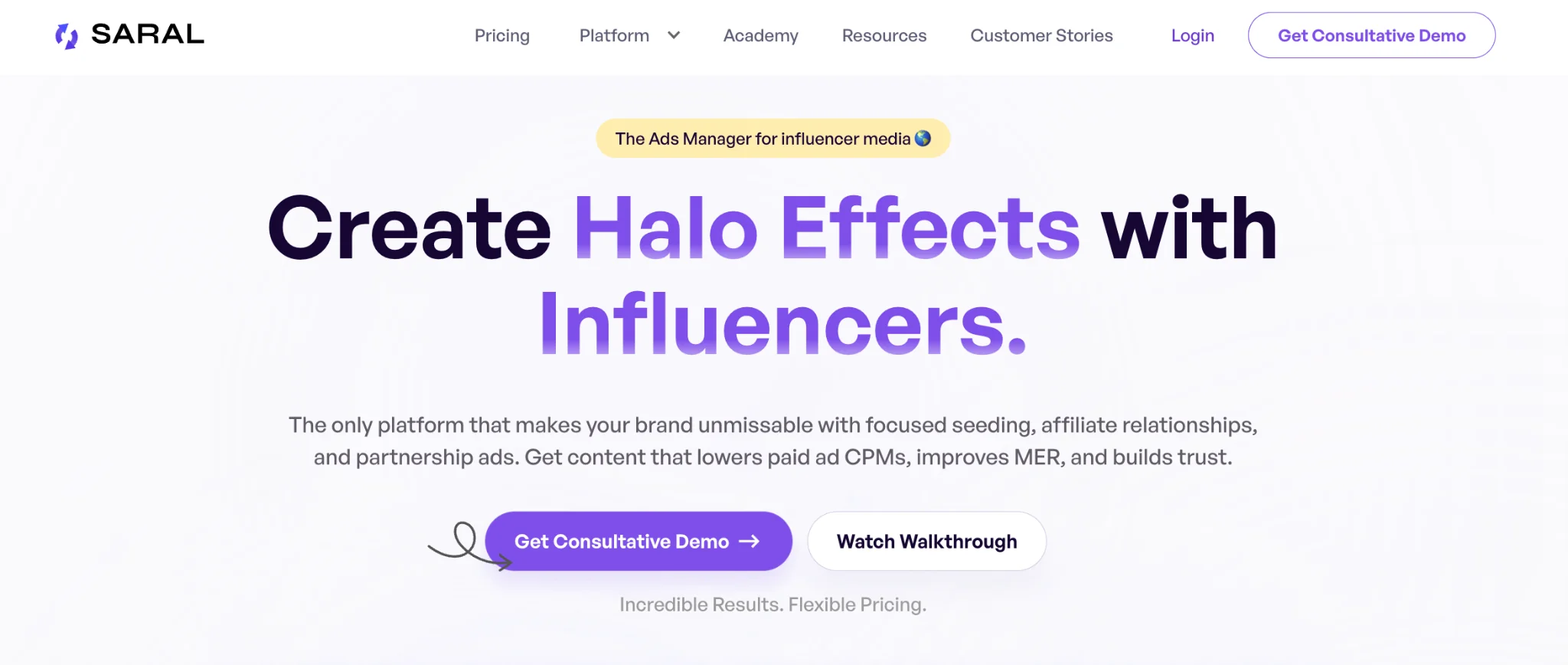
SARAL positions itself as a performance-oriented workspace for D2C brands that treat influencer marketing as an acquisition channel rather than a brand exercise. It combines discovery, outreach, affiliate tracking and UGC rights management with a heavy service component — every plan includes onboarding, a dedicated success manager and a shared Slack channel. The feature set is deliberately narrow but opinionated.
Key Features
- Influencer Search: a large index of creators built from public profiles with no creator registration required.
- Lookalike Generation: comparable creators generated from saved profiles rather than rebuilt through filters.
- Cookieless Affiliate Tracking: native affiliate links and commission tracking built into the core product.
- Social Listening: automatic detection when a partnered creator publishes.
- Ambassador Programs: application forms that convert existing customers into ongoing brand ambassadors.
Platform Coverage
Instagram, TikTok and YouTube.
Pricing
- Starter: $12,000/year covering 100 active partnerships and a single seat.
- Business: $15,000/year covering 500 active partnerships, unlimited post tracking and three seats.
- Professional: $25,000/year covering 1,000 active partnerships, unlimited social listening and ten seats.
Plans are sold in annual or quarterly blocks with no long-term contract beyond the billing period, and every tier includes expert-led onboarding and a dedicated success manager.
Reviews
4.8/5.0 (G2)
Standout Features
- Built-In Affiliate Attribution: commission tracking is native rather than dependent on a separate affiliate tool.
- Service at Every Tier: onboarding, a named success manager and a Slack channel included on the entry plan.
- Lookalike List Building: creator lists expand from proven performers instead of starting from scratch each time.
Minisocial vs SARAL
Both include a human layer, which makes them closer in spirit than most pairings on this list — but they apply it to different things. Minisocial's people run the campaign for you; SARAL's people teach your team to run it. The output differs accordingly: a folder of licensed assets versus a functioning in-house program with attribution attached.
Budget decides much of this. SARAL's $12,000 annual floor is four Minisocial campaigns, so the comparison only makes sense for brands committing to influencer marketing as a standing channel. For those brands, cookieless affiliate tracking and ambassador programs turn creator spend into measurable revenue, which is something no managed content service is structured to provide.
Traackr
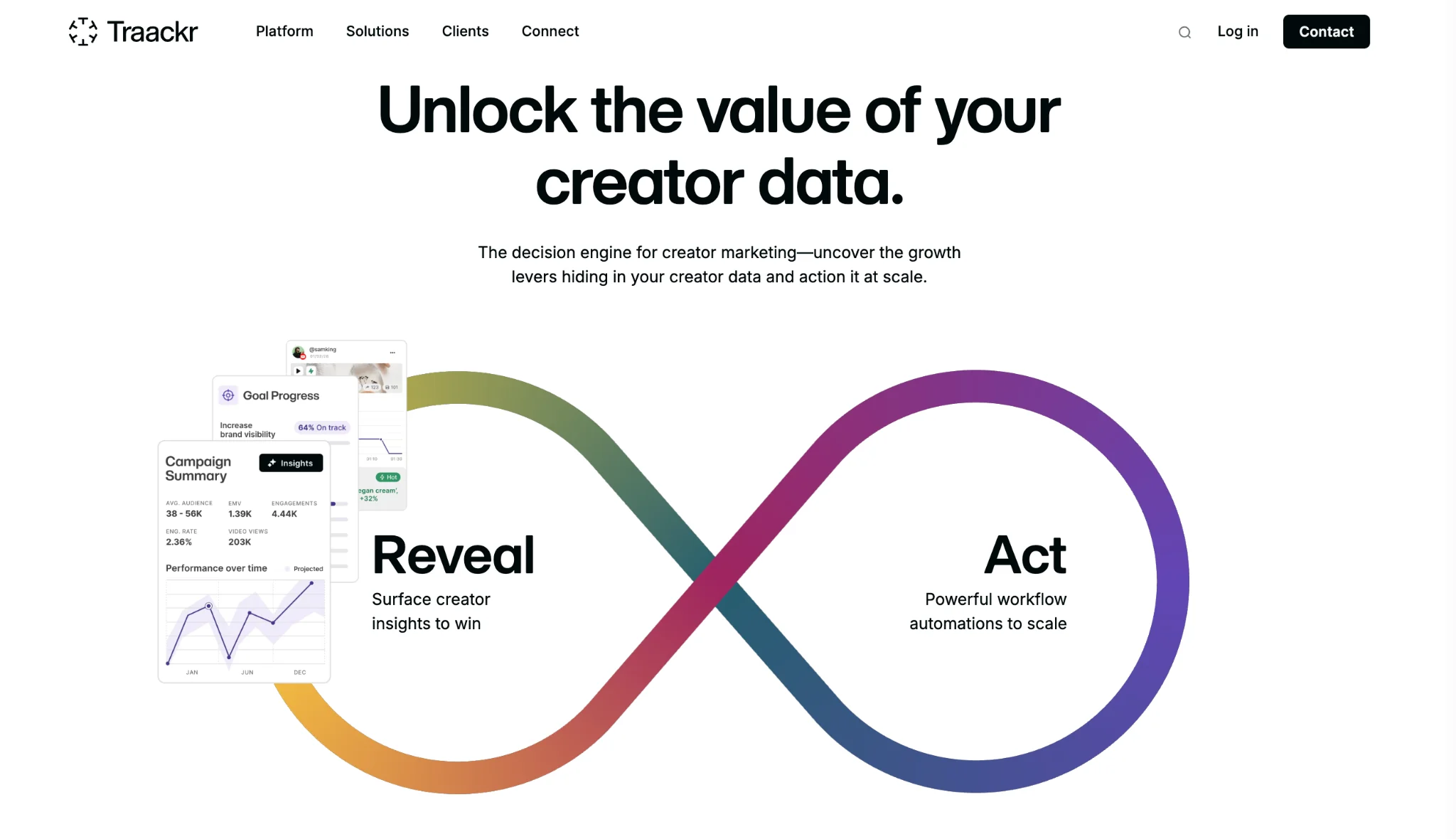
Traackr is an enterprise influencer relationship management and measurement platform built around data, benchmarking and program ROI rather than marketplace matchmaking. It serves large global brands and agencies, with particular strength in beauty, fashion and travel. The product is organised around planning, activation and measurement rather than around campaign execution.
Key Features
- AI Creator Discovery: content analysis, lookalike search and detailed audience data used to build shortlists.
- Relationship Management: centralised history of briefs, content and gifting for every creator partnership.
- Performance Benchmarking: creator and campaign results tied to business outcomes and compared against spend benchmarks.
- Competitive Intelligence: brand share-of-voice measured across a wide set of international markets.
- Community Health Tracking: creator acquisition, retention and churn metrics for programs at scale.
Platform Coverage
coverage spans the major social networks, though Traackr does not publish a definitive network list.
Pricing
- Custom Quote: no public pricing, with plans and packages set through a sales conversation.
- Entry Point: third-party listings place the starting cost well into five figures, though the billing period is reported inconsistently.
- Commitment: no free plan or free trial is offered.
Reviews
4.3/5.0 (G2)
Standout Features
- Cross-Market Benchmarking: performance compared against category peers across dozens of markets, not just against past campaigns.
- Depth of Relationship History: full partnership records that support long creator tenures rather than one-off activations.
- Budget Optimisation: spend reallocated across partnerships based on measured returns.
Minisocial vs Traackr
This is the widest gap on the list. Minisocial is a tactical purchase a marketing manager can approve; Traackr is an enterprise measurement system bought at director level with a procurement process attached. A brand comparing them is really deciding whether influencer marketing is a line item or a department.
Traackr's value is in proving the channel's contribution across markets and years, which is exactly the evidence a managed content service cannot produce. The trade-off is that it produces no assets and no execution — the brand still needs teams to brief, negotiate and create. Minisocial is the better fit for a brand that needs content this quarter; Traackr for one that needs to defend a seven-figure creator budget to a board.
Heepsy

Heepsy is a search-first discovery and outreach tool aimed at SMBs, eCommerce brands, startups and small agencies that want database access without an enterprise contract. It has broadened beyond pure discovery into outreach sequences, campaign pipelines and creator payments, but the search layer remains its centre. It has the lowest paid entry point of any platform in this comparison.
Key Features
- AI and Lookalike Search: intent-based search alongside lookalike and keyword modes across the creator database.
- Audience Authenticity Analysis: fake-follower detection and audience quality scoring on every profile.
- Bulk Outreach: templates, AI-composed emails and mailing sequences on higher tiers.
- Creator Marketplace: inbound applications from creators alongside outbound search.
- Campaign Pipelines: customisable pipelines with real-time media tracking and a content gallery.
Platform Coverage
Instagram, TikTok and YouTube.
Pricing
- Free: $0/month with a capped number of search results and advanced profile views.
- Starter: €69/month adding bulk emailing, templates and marketplace access.
- Plus: €149/month adding AI email composition, sequences, creator payments and analytics.
- Advanced: €229/month with the highest result and outreach limits plus custom reporting.
Reviews
4.5/5.0 (G2)
Standout Features
- Real Free Tier: a working free plan with no credit card, which makes evaluation genuinely low-risk.
- Authenticity Checks Everywhere: follower quality scoring applied across profiles rather than as a paid add-on.
- Lowest Paid Entry Point: paid access starts below €70/month, well under most alternatives here.
Minisocial vs Heepsy
For a brand with more time than budget, Heepsy inverts the Minisocial trade entirely. A single €69/month plan and a few weeks of outreach will typically produce more creator relationships than one $3,000 campaign, though the brand absorbs all the coordination work Minisocial would otherwise handle.
The honest limitation is depth. Heepsy is strongest at finding and contacting creators and thinner on measurement, so brands that need detailed attribution eventually outgrow it. What it does provide is ownership: the shortlists, the outreach history and the creator contacts all stay with the brand, which is precisely what a fully managed service never hands over.
Kolsquare
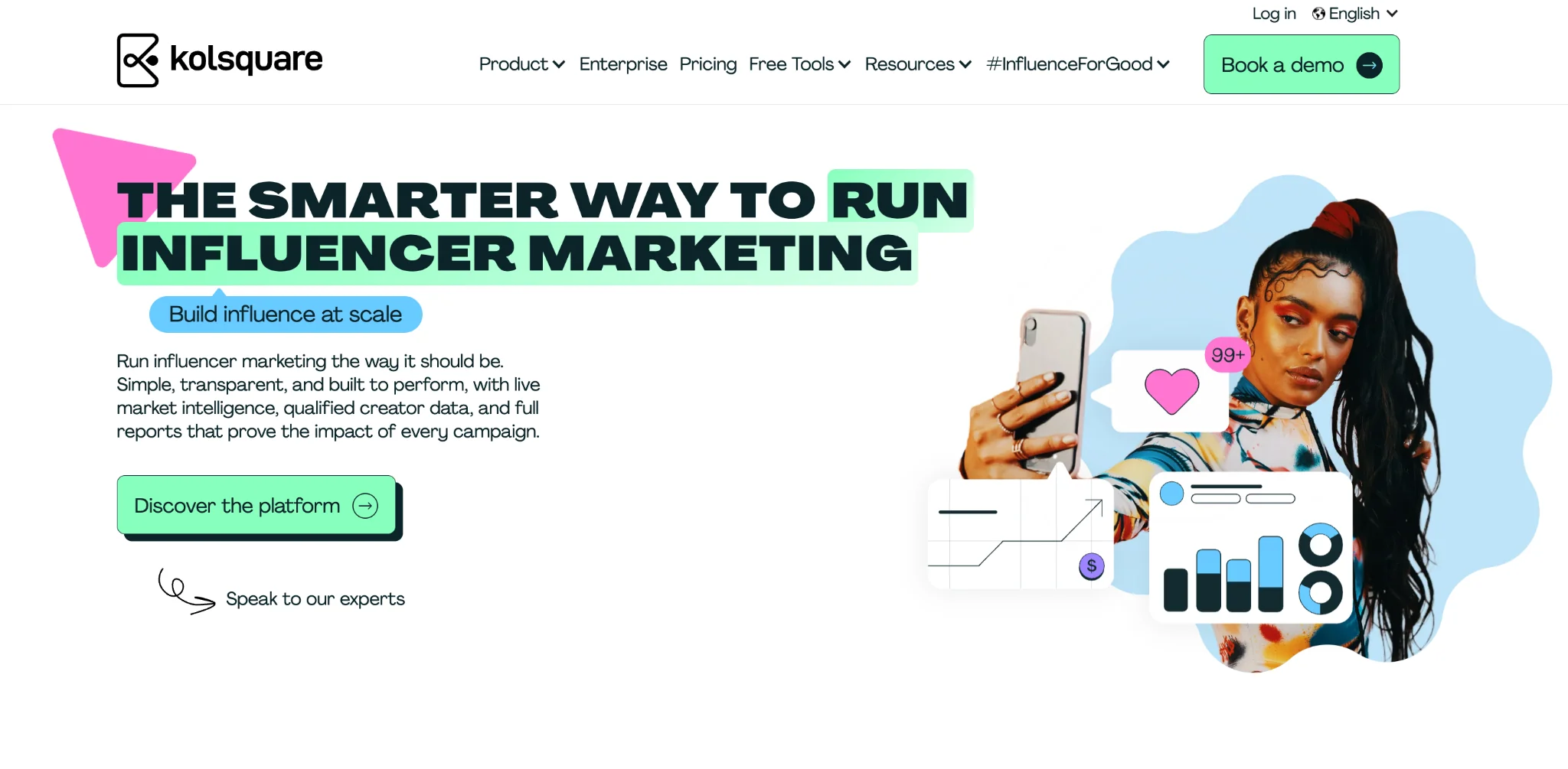
Kolsquare is a European influencer marketing platform combining AI-driven creator discovery, campaign management and social listening, used by a large base of brands and agencies across EU markets. It is notably strong on compliance and responsible-influence positioning, and its search technology leans on image recognition and speech-to-text rather than metadata alone. Coverage is deepest in European markets.
Key Features
- AI Creator Discovery: image recognition and speech-to-text search alongside multilingual keyword search and extensive filtering.
- Audience Overlap Analysis: demographic breakdowns plus overlap comparison and credibility scoring between creators.
- Influencer CRM: relationship management with custom fields, messaging integration and content validation.
- Social Listening: customisable dashboards benchmarking a brand against direct competitors with share-of-voice metrics.
- Automated Reporting: real-time dashboards, tracking links, ROI calculation and a Shopify plugin.
Platform Coverage
Instagram, TikTok, YouTube, Facebook and Snapchat, with listening dashboards focused on Instagram and TikTok.
Pricing
- Discovery: creator search, AI search, audience insights and integrated CRM, quoted on request.
- Listening: customisable competitor dashboards and share-of-voice benchmarking, quoted on request.
- Enterprise: adds influencer payments, API access, unlimited campaigns, tracking links and automated reporting.
No public pricing, free plan or free trial is offered, though published discounts exist for early-stage startups and non-profits.
Reviews
4.3/5.0 (G2)
Standout Features
- Visual and Audio Search: creators surfaced by what appears or is said in their content, not just by profile metadata.
- Listening Built In: competitor benchmarking and share of voice handled inside the same tool as creator management.
- European Market Depth: stronger coverage and compliance tooling across EU markets than most US-built platforms.
Minisocial vs Kolsquare
Geography is the cleanest dividing line. Minisocial's creator pool and case studies are US-centric, while Kolsquare's strength is European market coverage and the compliance requirements that come with it. A brand running campaigns across several EU markets will find Minisocial's roster thin and Kolsquare's local depth hard to replicate.
Beyond that, the two sit at opposite ends of the buying process. Minisocial publishes a price and starts within days; Kolsquare requires a demo and a quote but returns discovery, CRM, listening and reporting in one subscription. The right answer depends on whether the immediate need is content in hand or a system for choosing and measuring creators across markets.
Final Thoughts on Minisocial Alternatives
Minisocial does one job well — licensed creator content delivered without operational overhead — and the brands it suits are those that need assets more than they need a program. The alternatives above are worth considering when the requirement changes shape: when platform coverage needs to extend beyond Instagram and TikTok, when revenue has to be attributed to individual creators, or when the creator relationships and data should stay with the brand rather than the vendor.
Discovery-first tools like Heepsy and Modash lower the entry cost, marketplaces like Afluencer remove the budget floor entirely, and all-in-one systems like Influencer Hero and Upfluence replace the managed batch with an owned pipeline.
If the current question is simply what a campaign costs, the Minisocial pricing breakdown covers that in detail.