

Makeinfluence Pricing Explained: Plans, Features & Review
Paying creators for sales rather than posts sounds like the obvious fix for influencer marketing's measurement problem, right up until you ask who gets credit for what. Makeinfluence, a Copenhagen-built platform serving Nordic eCommerce, is one of the few that commits fully to that model: creators earn per click, per order, or per lead, brands see tracked revenue in a dashboard, and the whole relationship is settled on documented performance. Since 2020 it reports more than €65 million in revenue generated across 1,500-plus companies. What the performance framing does not mention is the subscription that sits underneath it. In this article, we break down Makeinfluence pricing, key features, reviews, limitations, and the best Makeinfluence alternatives to consider.
Makeinfluence Pricing
Makeinfluence publishes four plans, and each one charges twice: a monthly subscription plus a service fee levied on top of what creators earn.
- Entry costs €95 a month, or €80 billed annually, and covers 5 active influencers, one market, and one campaign, with a 30 percent service fee and a revenue cap of €6,700.
- Basic is €535 a month, or €455 annually, lifting that to 20 active influencers, one market, two campaigns, a 25 percent fee, and a dedicated customer success manager.
- Growth runs €805 a month, or €685 annually, with 50 active influencers, one market, four campaigns, and a 20 percent fee.
- Full Service Pro is €1,205 a month, or €1,025 annually, removing the limits on influencers, markets, and campaigns and dropping the fee to 15 percent.
- Optional onboarding is €670 on any plan, and annual billing saves roughly 15 percent. The structure rewards scale in both directions: bigger plans lift the caps and cut the percentage, so a brand generating real affiliate revenue on Entry is paying the highest fee on the most restricted plan.
Free Trial
There is no free trial advertised. The Entry plan functions as the low-commitment way in at €80 a month on annual billing, which is cheap enough to run a genuine pilot with a handful of creators in one market. Its €6,700 revenue cap is worth reading as a design decision rather than a limitation: the plan is built for testing whether performance-based creator partnerships convert in your category, not for running a program on.
Contract
Plans are subscriptions billed monthly or annually, with annual commitment discounted by around 15 percent. Cancellation and renewal terms deserve a close read before signing, since automatic renewal is one of the more common complaints raised about the platform. Set a calendar reminder ahead of the renewal date and confirm the notice period in writing, particularly if you are starting on an annual plan to capture the discount.
Makeinfluence Overview
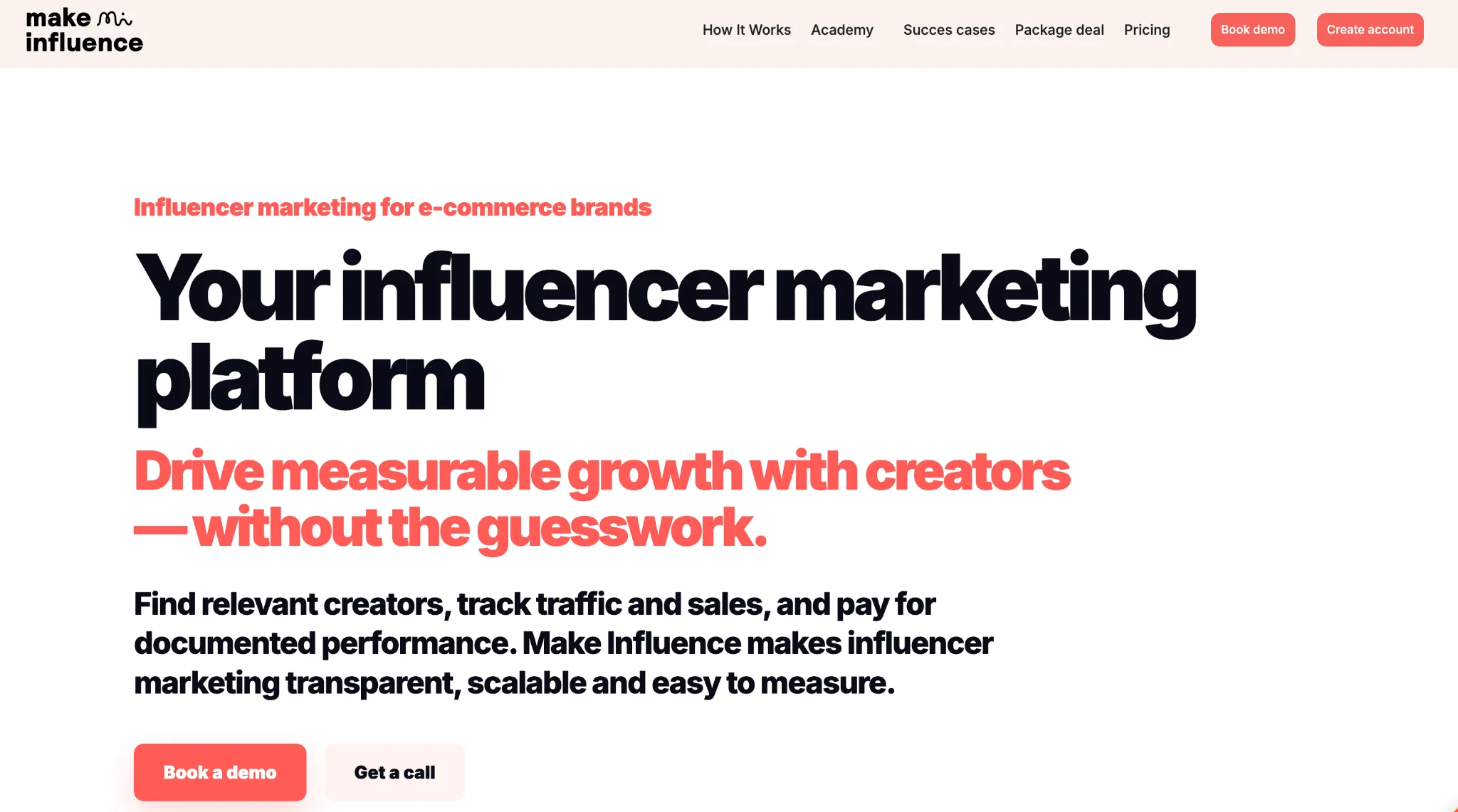
Makeinfluence is a performance-based influencer marketing platform built for eCommerce brands and the agencies serving them, with its centre of gravity in Denmark and Sweden and growing coverage in English-speaking markets. Rather than negotiating flat fees for posts, brands set a commission structure — cost per click, a percentage of each order, or a fixed price per lead — and creators earn against tracked results. A marketplace of more than 5,000 approved influencers handles recruitment, with data-driven matching suggesting relevant creators for a given brief. Around that sit real-time tracking of clicks, traffic, and sales, in-app chat, contract management, automated invoicing and payouts, and a content library. Named customers include PanzerGlass, Sinful, and Camille Brinch, and the platform reports over 930,000 sales facilitated and €8 million paid out to creators.
Key Features
Performance-Based Payment Models
Brands choose between cost per click, a percentage of order value, or fixed lead pricing, which lets the commercial structure match the business rather than forcing every partnership into the same shape.
Real-Time Sales and Traffic Tracking
Clicks, sessions, and orders attributed to each creator appear live in the dashboard, so a brand can see which partnerships are producing revenue during a campaign instead of after it.
Creator Marketplace With Vetting
More than 5,000 approved influencers are available to recruit from, with an application and approval process that filters the roster before brands ever see it.
Data-Driven Creator Matching
The platform suggests creators based on brand fit and past performance data, shortening the search for teams that do not have a name in mind when they start.
In-App Chat and Contract Management
Negotiation, briefing, and agreements happen inside the platform, keeping the commercial terms attached to the campaign record rather than scattered across inboxes.
Automated Invoicing and Payouts
Creator payments and the paperwork behind them are handled automatically, which is the part of affiliate-style programs that otherwise consumes a finance team as the roster grows.
Content Library
Creator content produced through campaigns is collected in one place, giving brands assets to reuse in paid social and owned channels.
Multi-Market Campaigns
Higher tiers unlock additional markets, which matters for Nordic brands selling across Denmark, Sweden, Norway, and beyond rather than in a single country.
Dedicated Customer Success Manager
From the Basic tier upward a named contact supports campaign setup and optimisation, which is unusual at this price point and reflects the platform's managed-service leaning.
Best For
Makeinfluence suits small and mid-sized eCommerce brands selling in the Nordics, particularly Danish and Swedish D2C companies that want creator partnerships measured in tracked sales rather than impressions. It fits teams comfortable with affiliate mechanics and willing to let commission structures do the negotiating, and the Entry plan makes it accessible to brands testing the channel for the first time. It is a weaker fit for brands outside its core markets, where the 5,000-creator roster thins out considerably, for programs built on gifting and brand content rather than conversion, and for anyone who dislikes paying a subscription and a percentage for the same partnerships.
Makeinfluence Reviews
3.5/5.0 (Trustpilot)
The rating sits on a reasonable review base and splits sharply, which is more informative than a uniform score would be. Positive feedback is consistent about the product itself: the platform is easy to navigate, campaign setup is straightforward, and support is responsive and helpful during onboarding.
The criticism clusters around three themes worth taking seriously before signing. First, several brands report paying for months while campaigns generated little activity and few sales, which points to roster depth varying by category. Second, billing complaints recur, specifically automatic renewals and difficulty cancelling. Third, and most technically interesting, the attribution model draws fire: a 30-day cookie window can credit a creator for purchases they did not meaningfully drive, which inflates reported performance and the fees calculated from it. Ask about attribution settings and cancellation terms explicitly during the sales conversation.
Makeinfluence Standout Features
Genuine Performance Pricing for Creators
Most platforms talk about ROI while still paying creators flat fees. Here the creator's earnings are tied to clicks, orders, or leads, which changes the incentive structure of the whole partnership and filters for creators confident they can actually sell.
A Service Fee That Falls as You Grow
Dropping from 30 percent on Entry to 15 percent on Full Service Pro means the platform takes a smaller cut precisely when a brand is spending the most, which is a fairer curve than flat-rate commission models offer.
Published Pricing in a Quote-Only Category
Listing four tiers, the caps on each, the service fee, and the onboarding cost publicly puts Makeinfluence in a small minority. A brand can model the total cost of a program before speaking to anyone, which is rare enough to count as a feature.
Makeinfluence Limitations
You Pay Twice
The subscription and the service fee are separate costs, so "only pay for results" describes half the arrangement. On Entry, a brand pays €95 a month before a single sale and 30 percent on every commission after.
Caps and Market Limits on Lower Tiers
Entry allows 5 creators, one market, one campaign, and €6,700 in revenue. Those constraints mean a program that starts working quickly forces an upgrade, which is fine if planned for and unwelcome if not.
Attribution Deserves Scrutiny
A 30-day cookie window is generous, and generous windows credit creators for sales that other channels earned. Since fees are calculated on attributed revenue, the attribution model is a cost question as much as a reporting one.
A Small, Regionally Concentrated Network
Five thousand approved creators is modest against databases running into the millions, and the roster is weighted toward Denmark and Sweden. Brands outside those markets should test category depth before committing.


Is Makeinfluence Worth It?
For a Nordic eCommerce brand that wants creator partnerships to behave like an affiliate channel, Makeinfluence is a credible and unusually transparent option: real performance mechanics, published prices, a fee that improves with scale, and a support model that includes a named contact from the second tier up. The caution flags are the double cost structure, the entry-level caps, the attribution window, and the billing complaints, all of which are manageable if raised before signing rather than discovered afterwards. Brands operating outside its core markets or running content-led programs should compare it against:
- Influencer Hero — an all-in-one platform pairing creator discovery and outreach automation with CRM, gifting, influencer affiliate management, and ROI reporting across eight networks.
- Afluencer — a marketplace where brands post collaborations and creators apply, giving access to a wider English-language creator pool than a regionally focused roster.
- Social Snowball — affiliate and ambassador program software built for Shopify brands, with automated payouts and referral tracking.
- Refersion — affiliate management with granular commission rules and eCommerce integrations for brands running large partner programs.
- Awin — an established global affiliate network with creator partnerships alongside traditional publishers and broad market coverage.
Final Thoughts
The right way to evaluate Makeinfluence is as affiliate infrastructure with a creator marketplace attached, not as a general influencer platform that happens to track sales. That framing makes the decision clearer: if your economics work at a 15 to 30 percent fee on attributed revenue, and your market is one where the roster is genuinely deep, the model is sound and the transparency is a real advantage. If your creator program is about content, gifting, and building awareness, performance pricing will not capture what you are buying. Pressure-test the attribution window against your own analytics before scaling spend, since that single setting determines both what you report and what you pay.