

Linqia Pricing Explained: Plans, Features & Review
Enterprise marketers who want influencer campaigns run for them, rather than another dashboard to staff, tend to end up looking at Linqia. It pairs a full-service team with a proprietary platform, taking on strategy, creator negotiation, content approval, and paid amplification so internal teams can stay lean. That hands-off model is exactly what makes it a strong fit for some brands and a poor one for others: the trade-off is less direct control, opaque pricing, and budgets that assume a managed engagement rather than a monthly software seat.
In this article, we break down Linqia pricing, key features, reviews, limitations, and the best Linqia alternatives to consider.
Linqia Pricing
Linqia does not publish pricing. It operates as a managed influencer marketing agency with a bundled platform, so costs are quoted per brand based on campaign scope, creator volume, paid media, and the level of service involved rather than off a public rate card. In practice that means engagements are sold as programs, not seats, and budgets tend to sit at the enterprise end because a dedicated team is doing the sourcing, contracting, and reporting on your behalf. There is no free tier and no month-to-month self-serve option, so the entry point is a conversation with sales rather than a checkout page.
Free Trial
No. Linqia does not offer a free trial or a free version. Because the platform is delivered alongside managed services, access starts after a consultation and a scoped agreement rather than a self-guided signup.
Contract
Engagements are custom and typically structured around an annual or per-campaign commitment. Terms, deliverables, and paid-media spend are negotiated up front, so there is no standard lock-in period published, but expect a defined scope rather than a cancel-anytime subscription.
Linqia Overview

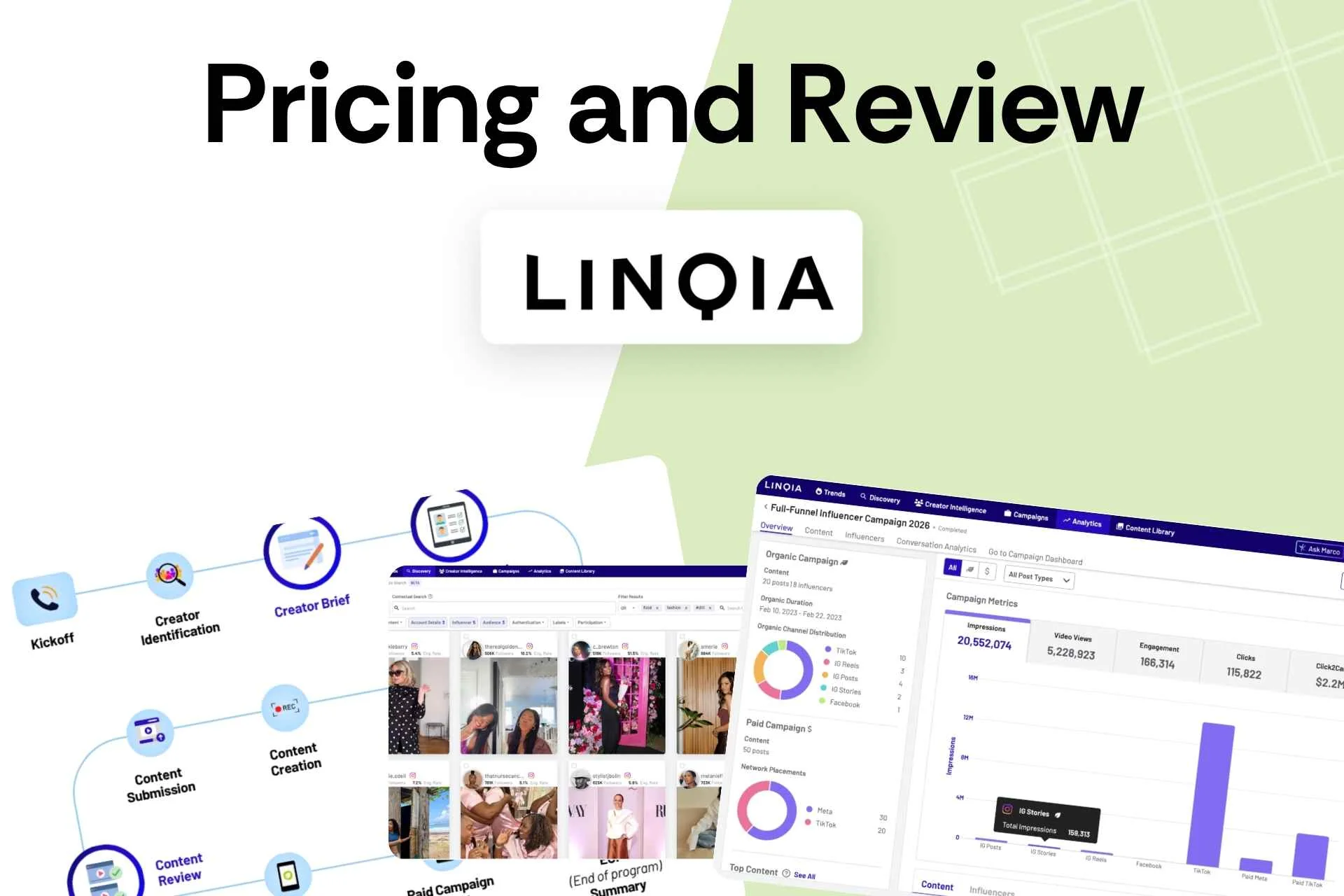
Linqia is a full-service influencer marketing company that combines a strategist-led team with its own technology to run creator campaigns for large brands. Rather than handing clients a self-serve tool, it manages the heavy lifting end to end, from identifying and negotiating with creators to approving content, amplifying it as paid media, and measuring results. Its clients skew toward established enterprises across retail, CPG, and healthcare, and the company leans heavily on third-party measurement partnerships to validate outcomes. The proprietary side of the offering is Resonate, an AI-assisted workflow used for discovery, briefing, approvals, and analytics across major social platforms.
Key Features
Managed Campaign Execution
Linqia's core product is people, not just software. A dedicated team handles strategy, creator outreach, negotiation, contracting, and content review, which removes most of the operational load from in-house marketers and makes it attractive to brands without a large influencer team.
Resonate Platform and Marco AI
Resonate is the proprietary workflow layer that supports creator discovery, brief distribution, content approvals, and performance dashboards, with an AI assistant, Marco, designed to speed up campaign setup and reduce manual coordination.
Paid Amplification
Beyond organic posts, Linqia turns high-performing creator content into paid social media, extending reach and giving brands a way to scale the assets that work rather than relying on organic distribution alone.
Third-Party Measurement
Linqia integrates with a range of independent measurement and social-listening partners so results are validated externally, a deliberate position it frames as not grading its own homework, which resonates with enterprise buyers who need defensible reporting.
Multi-Platform Coverage
Campaigns run across the major networks brands care about, including Instagram, TikTok, YouTube, Facebook, and Pinterest, so a single program can span the channels where a target audience actually spends time.
Best For
Linqia fits enterprise and upper-mid-market brands that want influencer marketing delivered as a managed service rather than run in-house. It suits teams with meaningful budgets, a need for defensible third-party measurement, and a preference for offloading creator sourcing, negotiation, and paid amplification to an external partner, particularly those focused on North American audiences. It is a weaker fit for smaller brands, hands-on operators who want direct control of every creator relationship, or teams that need transparent, self-serve pricing.
Reviews
4.8/5.0 (G2)
Linqia earns strong marks for service quality, with reviewers repeatedly praising clear communication, timeliness, and a team that works within client budgets, while creators note fair compensation and creative freedom. The recurring criticisms are about the model and the platform rather than the people: some users find the interface confusing at first, content submission and approval workflows could be smoother, and enterprise clients want better multi-user collaboration inside the tool. The review base is relatively small compared with self-serve platforms, which reflects Linqia's managed, lower-volume client model.
Linqia Standout Features
Marco AI Campaign Assistant
Marco is Linqia's AI layer inside Resonate, built to simplify campaign planning and execution by speeding creator matching and reducing the manual steps between brief and live campaign.
Independent Measurement Network
Linqia's integration with numerous third-party measurement and social-listening partners is a genuine differentiator, giving brands externally validated performance data instead of vendor-reported metrics alone.
Creator Content to Paid Media Pipeline
The ability to systematically promote top-performing creator content as paid social sets Linqia apart from tools that stop at organic posting, letting brands scale proven assets across the funnel.
Linqia Limitations
No Transparent or Self-Serve Pricing
Every engagement requires a custom quote and a sales conversation, with no public plans and no free trial, which slows evaluation and rules Linqia out for teams that want to test software before committing.
Managed Model Means Less Direct Control
Because Linqia runs campaigns for you, brands that prefer to own creator relationships day to day, move quickly, or manage outreach themselves can find the agency layer limiting rather than freeing.
Geographic Constraints on Creators
Linqia's creator network centers on the U.S. and Canada, which is a real limitation for brands running global programs or targeting audiences outside North America.
Platform Depth and Usability Gaps
Reviewers note a learning curve, confusing first-time navigation, and self-serve discovery filtering that is thinner than dedicated software, so the platform on its own is less flexible than purpose-built SaaS tools.


Is Linqia Worth It?
For enterprise brands that want influencer marketing handled by a capable team and need externally validated results, Linqia can absolutely earn its cost. The service reputation is strong, the measurement approach is credible, and the paid amplification pipeline adds real reach. The catch is fit: if you want transparent pricing, self-serve control, broader geographic coverage, or software you run in-house, the managed model and opaque quotes may not match how your team works. Brands weighing that trade-off usually shortlist a few alternatives before deciding.
- Influencer Hero — an all-in-one platform that combines discovery across eight networks, automated outreach, CRM-style relationship tracking, and ROI reporting with publicly listed pricing, giving brands the automation of software plus the scale a managed program promises.
- Afluencer — a creator marketplace where brands post campaigns and vetted influencers apply, useful for teams that want inbound creator matches without a heavy agency retainer.
- Upfluence — a large searchable creator database with AI matching and a live-capture browser extension, suited to brands that want deep self-serve discovery and e-commerce integrations.
- CreatorIQ — an enterprise-grade platform focused on large-scale program management, data integrations, and governance for brands running sophisticated, always-on creator operations.
- Traackr — a data-first influencer relationship management platform built around vetting, benchmarking, and performance measurement for teams that prioritize rigorous analytics.
Final Thoughts
Linqia's strength is convenience at the enterprise level: hand it a brief and a budget, and a team plus a platform will run the program and prove it worked. Whether that is the right call depends on how much control and pricing transparency you are willing to trade for a done-for-you service. If the managed approach or the custom quotes give you pause, it is worth comparing self-serve platforms that offer similar reach at a clearer cost before you commit.