

GRIN vs Aspire vs CreatorIQ: Pricing, Features, and Platform Comparison
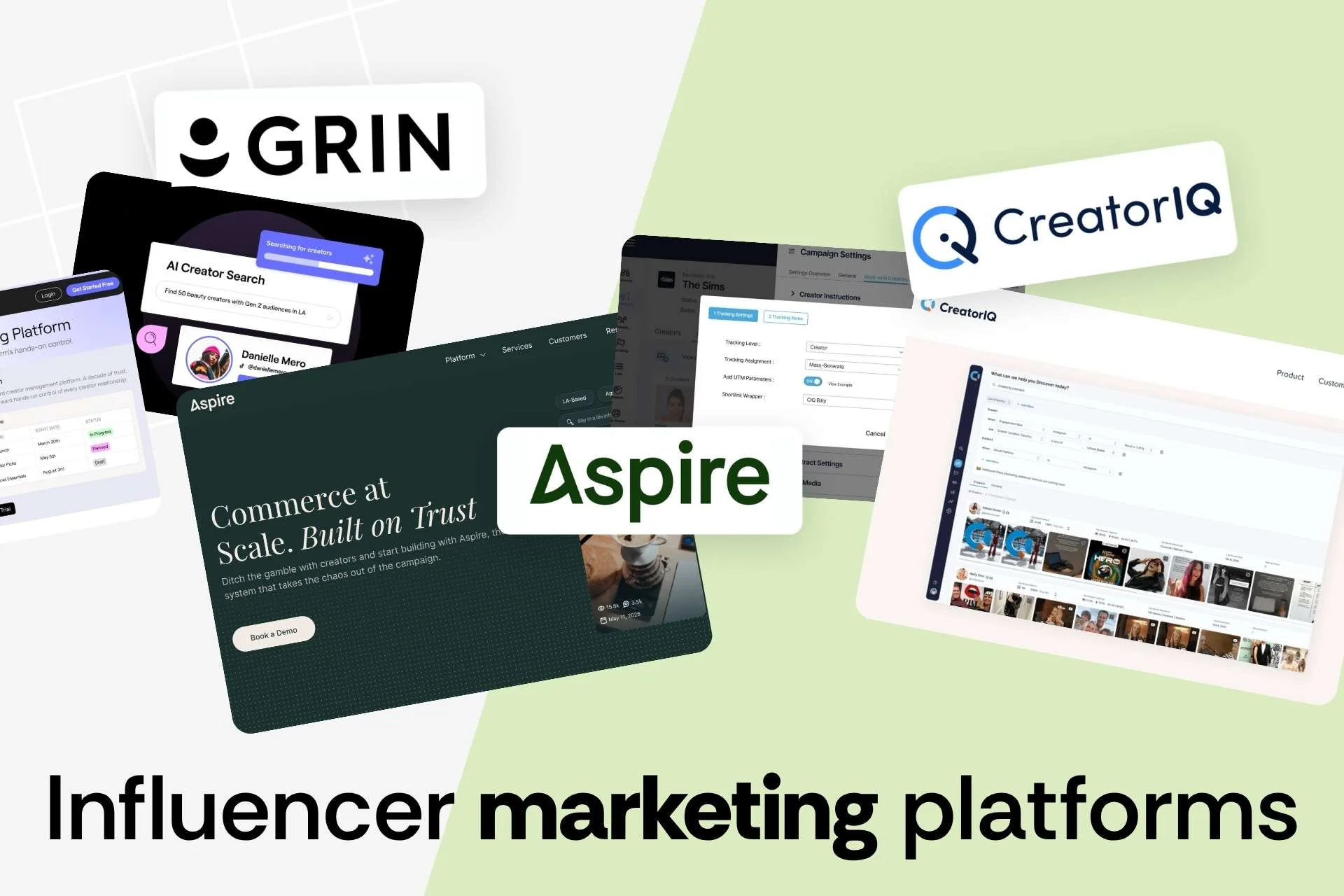
Choosing the right influencer marketing platform directly impacts how efficiently teams manage creator relationships, track ROI, and scale campaigns—especially for eCommerce brands running gifting, affiliate, and paid collaborations at volume. While GRIN, Aspire, and CreatorIQ all position themselves as end-to-end solutions, their core strengths differ significantly. GRIN is built specifically for DTC brands with deep Shopify integrations, unlimited creator partnerships, and built-in payments, whereas Aspire stands out with its inbound creator marketplace and workflow automation that reduces manual outreach. CreatorIQ, on the other hand, is designed for enterprise teams, offering highly customizable reporting, global data access (no opt-in required), and advanced campaign approval workflows.
In this article, we’ll dive deep into the comparison between GRIN vs Aspire vs CreatorIQ, exploring their features, pricing, and overall platform capabilities to help you decide which is best for your brand.
GRIN vs Aspire vs CreatorIQ
Influencer Discovery and Database
GRIN focuses on a large (200M+) but primarily opt-in creator database, which tends to surface creators already open to brand collaborations—useful for DTC teams prioritizing conversion. Aspire differentiates itself with a hybrid approach: outbound search plus a 1M+ inbound marketplace where creators actively apply, reducing sourcing time. CreatorIQ stands out with full access to public creator data (no opt-in), offering the most flexibility and depth for enterprise-level discovery and global campaigns.
Suggestion: Choose GRIN for high-intent creator sourcing, Aspire for reducing outbound effort via inbound applications, and CreatorIQ for maximum discovery scale and data control.
Influencer Outreach
GRIN emphasizes email-first outreach with deep integrations (Gmail, Outlook, Klaviyo) and inbound creator applications via landing pages, making it efficient for scaling relationship-based programs. Aspire goes further with workflow automation—automated follow-ups, bulk actions, and stage-based triggers—reducing manual campaign management. CreatorIQ provides robust but more traditional outreach tools, with bulk messaging, templates, and CRM tracking designed for structured, team-based collaboration.
Suggestion: Aspire is best for automation-heavy teams, GRIN for relationship-driven outreach tied to eCommerce, and CreatorIQ for structured outreach across large teams.
CRM and Campaign Management
GRIN offers a highly flexible CRM with unlimited creator partnerships and built-in payments, making it ideal for brands running high-volume, always-on programs. Aspire provides a strong, automation-driven workflow (from invite to content approval), helping teams streamline operations without adding complexity. CreatorIQ delivers enterprise-grade CRM capabilities, including advanced approval workflows (like one-sheet approvals) and deep internal collaboration tools.
Suggestion: Use GRIN for scaling creator volume, Aspire for operational efficiency, and CreatorIQ for complex, multi-stakeholder campaign management.
Reporting and Analytics
GRIN is heavily focused on ROI, tying influencer activity directly to revenue, conversions, and affiliate performance—especially ძლიერი for Shopify-driven brands. Aspire provides solid campaign-level reporting with sales tracking, but is more execution-focused than analytics-heavy. CreatorIQ leads in analytics, offering highly customizable dashboards, real-time API data integrations, and executive-ready reporting across global campaigns.
Suggestion: GRIN is best for eCommerce ROI tracking, Aspire for straightforward performance insights, and CreatorIQ for advanced analytics and reporting depth.
Product Gifting
GRIN and Aspire both offer deep Shopify integrations, but differ in execution—GRIN automates product selection via storefronts, while Aspire adds more control with approval workflows and budget rules before fulfillment. CreatorIQ also supports gifting through Shopify, but it’s less central to the platform compared to the other two.
Suggestion: Choose GRIN for automation, Aspire for control and flexibility, and CreatorIQ if gifting is a secondary part of a broader enterprise strategy.
UGC Collection
GRIN stands out with automatic media rights management and a centralized UGC library that includes even ephemeral content like Instagram Stories. Aspire provides a solid content library with usage rights, but with less automation around rights management. CreatorIQ offers robust content tracking and reuse capabilities, including visibility into how content performs when repurposed (e.g., paid media).
Suggestion: GRIN is best for brands heavily leveraging UGC at scale, Aspire for straightforward content management, and CreatorIQ for enterprise-level content tracking and reporting.
Pricing
GRIN typically starts around $2,500/month ($25K+/year) with custom pricing and required annual contracts, positioning it for mid-market to enterprise eCommerce brands. Aspire is similarly priced (~$2,300/month mid-tier) but offers more flexibility depending on campaign scale and team size. CreatorIQ operates at a significantly higher price point, starting around $35,000/year and scaling up to $200,000+, reflecting its enterprise focus.
Suggestion: Aspire offers the most balanced pricing for growing teams, GRIN is ideal for established DTC brands with budget and scale, and CreatorIQ is best suited for large enterprises with complex global needs.


GRIN Overview

GRIN is an end-to-end influencer marketing platform built primarily for eCommerce and DTC brands looking to manage creator relationships at scale. It combines influencer discovery, CRM, product seeding, payments, and affiliate tracking into one system, allowing teams to run campaigns without relying on multiple tools. For discovery specifically, GRIN uses a large opt-in creator database alongside AI-powered lookalike search and keyword filtering to help brands find high-fit creators who are already open to partnerships.
Key Features
- Influencer Discovery Suite: Search creators using keywords, audience data, engagement metrics, and AI-powered lookalike matching.
- Creator CRM: Manage all influencer relationships in a centralized CRM with customizable pipelines and tagging.
- Email Outreach & Communication: Sync Gmail/Outlook to send and track emails directly within the platform.
- Product Gifting & Fulfillment: Native Shopify integration allows creators to select products and automates order tracking.
- Affiliate & Sales Tracking: Track clicks, conversions, revenue, and commissions tied to each creator.
- In-App Payments: Pay influencers directly through PayPal without leaving the platform.
- UGC Content Library: Store and organize all creator content, including Instagram Stories, for reuse.
- Landing Pages for Recruitment: Build branded pages to attract inbound creator applications.
- Chrome Extension: Add creators directly from social platforms and view real-time analytics.
- AI Assistant (Gia): Helps identify, qualify, and prioritize creators while streamlining workflows.
Platform Coverage
GRIN supports major social platforms including Instagram, TikTok, YouTube, X (Twitter), Twitch, and Snapchat.
Standout Features
- Unlimited Creator Partnerships: Unlike many competitors, GRIN does not cap the number of influencers you can manage, making it ideal for scaling large programs.
- Deep eCommerce Integration: Native Shopify and PayPal integrations enable seamless gifting, order tracking, and payments in one workflow.
- Automated Media Rights Management: Creator contracts automatically include content usage rights, simplifying UGC reuse across marketing channels.
Limitations
- Pricing is relatively high, with annual commitments that can be restrictive for smaller teams.
- Creator database is limited to opt-in influencers, which may reduce discovery breadth compared to open databases.
- No native tools for paid media amplification (e.g., boosting influencer posts as ads).
- Some users report that initial onboarding and setup can take time due to the platform’s depth.
Integrations
- Shopify: Sync product catalogs, automate gifting, and track orders directly within campaigns.
- PayPal: Process and send influencer payments globally without leaving the platform.
- Gmail / Outlook: Manage outreach and communication with creators directly from your existing inbox.
- Klaviyo: Align influencer campaigns with email marketing flows and customer data.
- Stripe: Support payment processing and financial workflows tied to influencer campaigns.
Pricing
GRIN uses custom pricing, typically starting around $2,500/month (or $25,000/year) with a required annual contract and scaling based on features and usage. There is no free trial publicly available, and pricing often requires a demo and consultation to finalize.
Reviews
4.5 / 5.0 (G2)
Aspire Overview
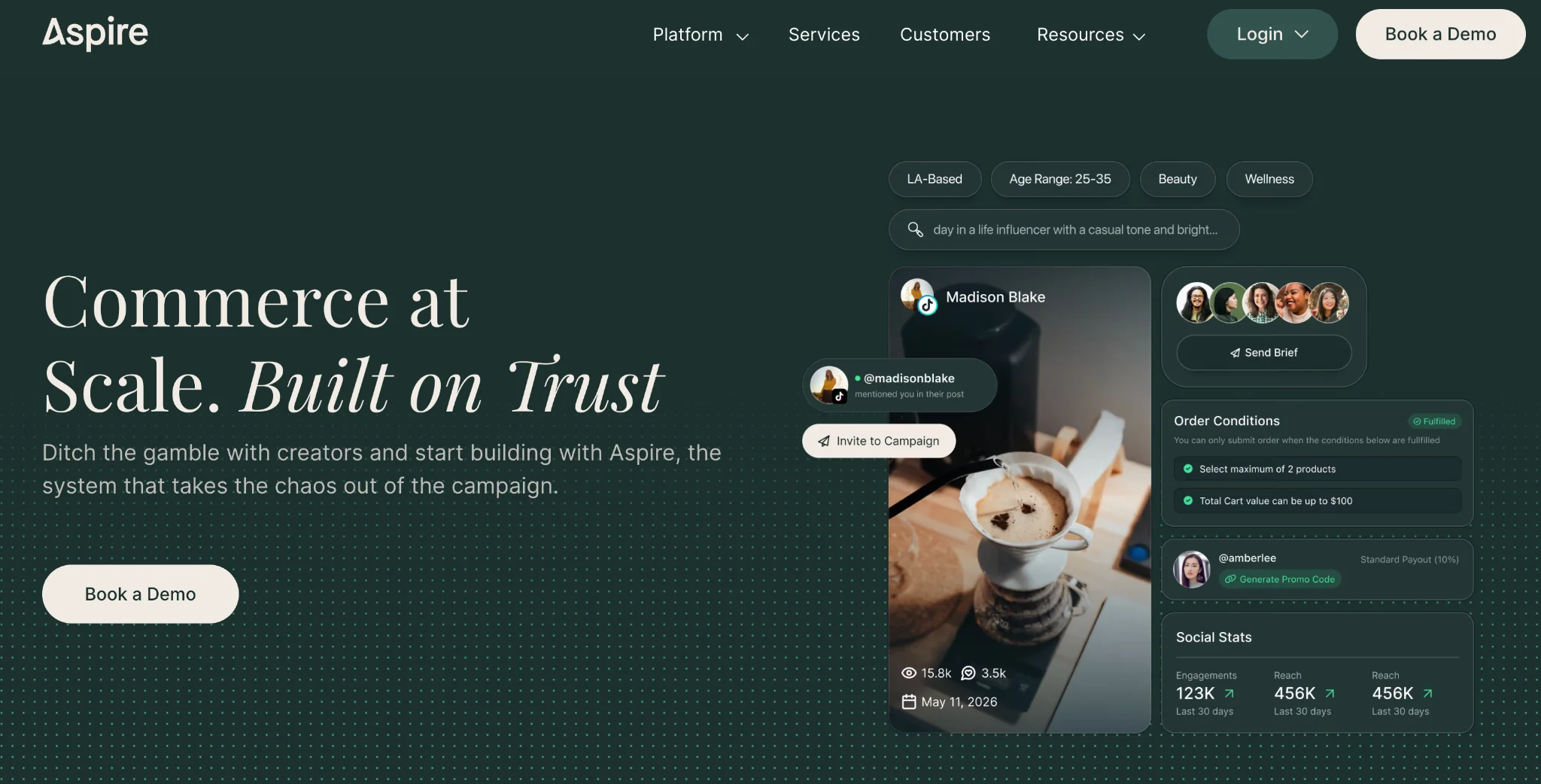
Aspire is an end-to-end influencer marketing platform designed to streamline creator discovery, outreach, and campaign execution for growing and enterprise brands. It stands out for combining traditional influencer search with a large inbound creator marketplace, where over 1M creators actively apply to campaigns—reducing the need for manual sourcing. Discovery is powered by first-party data integrations (Meta, TikTok, Pinterest), giving brands more reliable audience insights compared to scraped data.
Key Features
- Influencer Discovery & Search: Find creators using filters like demographics, engagement, and keywords, powered by first-party platform data.
- Inbound Creator Marketplace: Access a network of over 1M creators who apply directly to campaigns, reducing outbound effort.
- Application Pages: Create custom landing pages to attract and pre-qualify influencers with detailed submission forms.
- Workflow Automation: Automate campaign steps such as follow-ups, approvals, and contract management.
- Creator CRM: Organize influencers with tagging, lists, and pipeline tracking for better relationship management.
- Product Gifting & Fulfillment: Integrates with Shopify to allow creators to select products and track fulfillment without leaving the platform.
- Sales & Affiliate Tracking: Monitor clicks, conversions, revenue, and commissions tied to influencer campaigns.
- Content Library: Store, manage, and reuse influencer-generated content with associated usage rights.
- Email Integration: Sync Gmail to manage all outreach and communication within the platform.
- Reporting & Analytics: Track campaign performance across channels with exportable reports and creator-level insights.
Platform Coverage
Aspire supports major platforms including Instagram, TikTok, YouTube, and Pinterest, with a primary focus on social commerce and content-driven channels.
Standout Features
- Inbound Creator Marketplace: One of Aspire’s biggest advantages is its large pool of creators actively applying to campaigns, significantly reducing sourcing time.
- First-Party Data Integrations: Direct integrations with platforms like Meta and TikTok provide more accurate audience and performance data compared to scraped databases.
- Workflow Automation: Advanced automation across outreach, follow-ups, and approvals helps teams scale campaigns without increasing manual workload.
Limitations
- Pricing can be high for smaller brands, especially as usage scales.
- Limited support for niche or emerging platforms beyond core social channels.
- Payment processing is less native compared to competitors (often requiring external tools).
- Some users find reporting less customizable compared to enterprise-focused platforms.
Integrations
- Shopify: Sync product catalogs and automate influencer gifting and fulfillment workflows.
- Gmail: Manage influencer outreach, send bulk emails, and track communication directly within Aspire.
- Meta (Facebook & Instagram): Access first-party audience data and performance insights for more accurate influencer evaluation.
- TikTok: Leverage native data integrations for improved discovery and campaign tracking.
- Pinterest: Use first-party data to discover creators and analyze performance on the platform.
Pricing
Aspire offers tiered, customizable pricing starting around $2,300/month, depending on the number of creators and features required. There is no publicly available free trial, and pricing typically requires a demo and consultation, with flexibility based on campaign scale and team size.
Reviews
4.7 / 5.0 (G2)
CreatorIQ Overview
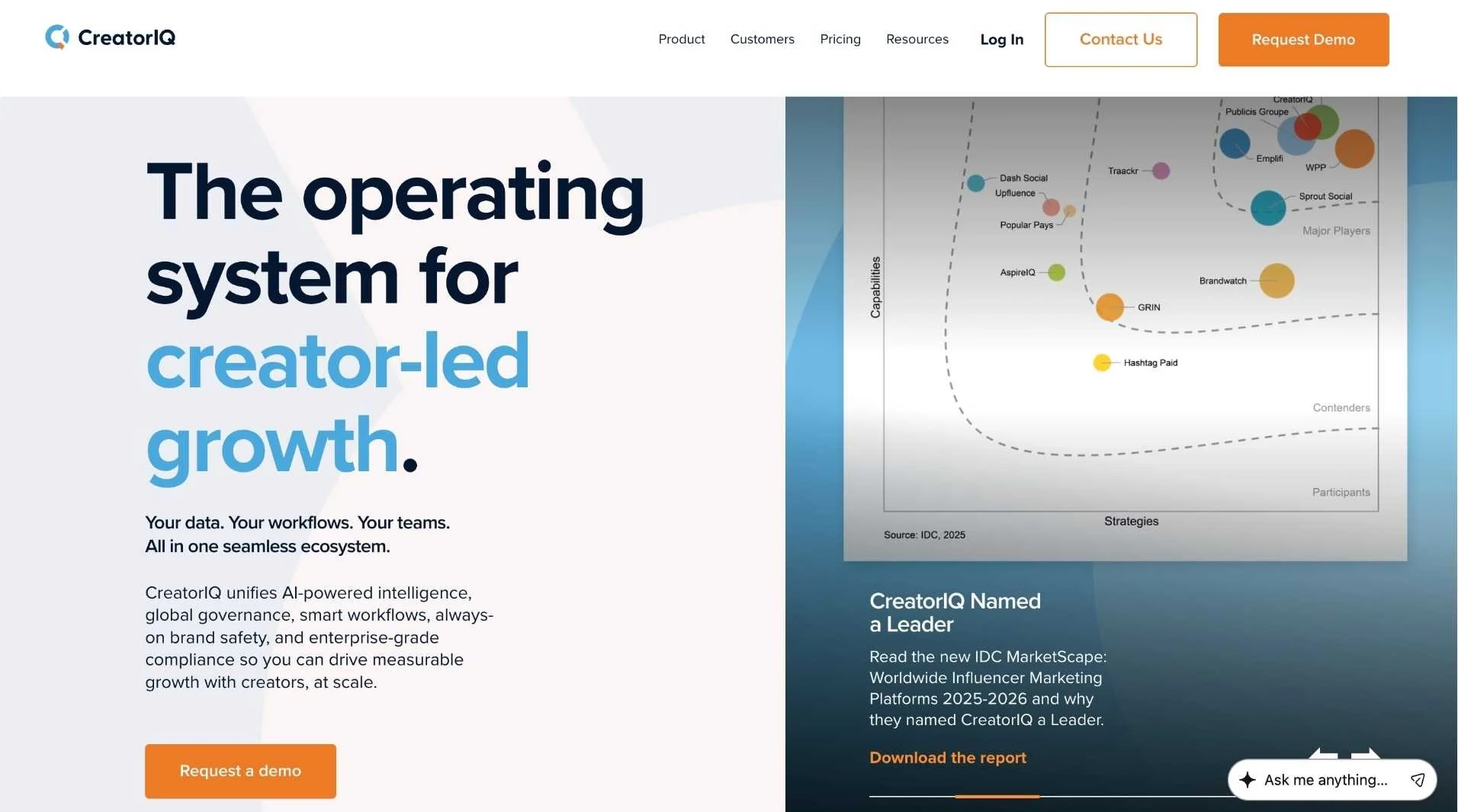
CreatorIQ is an enterprise-grade influencer marketing platform designed for large brands and agencies managing global creator programs at scale. It provides advanced influencer discovery by indexing public social data (not limited to opt-in creators), allowing teams to search, filter, and analyze virtually any creator across major platforms. The platform is built around data control, compliance, and deep customization, making it particularly suited for organizations with complex workflows and reporting needs.
Key Features
- Global Influencer Discovery: Search a massive database of public creator profiles with advanced filters for audience demographics, brand affinity, and engagement quality.
- AI-Powered Search & Recommendations: Use semantic search and machine learning to identify relevant creators beyond simple keyword matching.
- Creator CRM: Manage relationships with detailed creator profiles, notes, tagging, and historical campaign data.
- Campaign Management Workflows: Plan, execute, and track campaigns with customizable workflows, approvals, and task assignments.
- Content Tracking & Library: Automatically collect and organize all influencer content with visibility into usage rights and performance.
- Advanced Reporting & Dashboards: Build highly customizable reports with metrics like EMV, engagement, reach, and conversions.
- Compliance & Payments Management: Handle contracts, tax forms, and global payments with built-in compliance tools.
- Collaboration Tools: Enable cross-functional teams (legal, finance, marketing) to collaborate within structured workflows.
- Social Listening & Brand Mentions: Monitor organic creator mentions and brand sentiment beyond paid campaigns.
- API Access & Data Integration: Connect CreatorIQ with internal BI tools for deeper analysis and reporting.
Platform Coverage
CreatorIQ supports all major social platforms including Instagram, TikTok, YouTube, Facebook, X (Twitter), Twitch, and additional global networks depending on data availability.
Standout Features
- Open Data Discovery (No Opt-In Required): Access and analyze virtually any public creator profile, giving unmatched flexibility for global influencer sourcing.
- Enterprise-Grade Reporting & Customization: Highly configurable dashboards and API integrations allow teams to tailor reporting to internal KPIs and executive needs.
- Advanced Workflow & Approval Systems: Features like one-sheet approvals and multi-layer workflows make it ideal for large teams with strict processes and compliance requirements.
Limitations
- High cost of entry, making it less accessible for small to mid-sized brands.
- Steeper learning curve due to the platform’s complexity and depth of features.
- Setup and onboarding can be time-intensive, especially for teams without dedicated resources.
- Gifting and eCommerce workflows are less native compared to DTC-focused platforms.
- Some users find the UI less intuitive compared to more modern, streamlined tools.
Integrations
- Shopify: Sync product catalogs and manage influencer gifting workflows within campaigns.
- Salesforce: Connect influencer data with CRM systems for better alignment with sales and customer data.
- Google Analytics: Track website traffic and conversions driven by influencer campaigns.
- Meta (Facebook & Instagram): Access first-party performance data and insights for campaign tracking.
- TikTok: Integrate native platform data for more accurate creator analytics and reporting.
Pricing
CreatorIQ offers custom enterprise pricing, typically starting around $35,000/year and scaling up significantly based on features, data access, and global usage. There is no free trial, and contracts are usually annual, reflecting its focus on large organizations.
Reviews
4.4 / 5.0 (Capterra)
Final Thoughts
Choosing between GRIN, Aspire, and CreatorIQ ultimately comes down to how your team prioritizes scale, automation, and data depth. GRIN is best suited for eCommerce brands that want tight integration with Shopify, strong ROI tracking, and the ability to manage unlimited creator relationships. Aspire offers a balanced approach with its inbound creator marketplace and workflow automation, making it a strong choice for teams looking to reduce manual effort while still scaling campaigns efficiently. CreatorIQ, on the other hand, is built for enterprise organizations that require advanced reporting, global discovery without opt-in limitations, and highly customizable workflows.
For most mid-market brands, Aspire provides the best balance between usability, automation, and cost, while GRIN is ideal for DTC brands heavily focused on product seeding and affiliate-driven growth. Larger enterprises with complex team structures and reporting requirements will benefit most from CreatorIQ. The right choice depends on your internal resources, campaign scale, and how much control and customization your influencer marketing program requires.